Faculty publication

Professors Harmon and Hwang in UConn Today: NFL Stadium Attendance Protest Impact Depended on Who Visited

Professors Oskar Harmon and Jungbin Hwang are featured in the current edition of UConn Today:

Home or Away? NFL Stadium Attendance Protest Impact Depended on Who Visited, Researchers Find
How do player politics affect fan attendance? The answer is complicated

Research inspiration can come from any number of places.

For Oskar Harmon, an associate professor in the Department of Economics at UConn, a recently published paper was inspired by a conversation with a friend.

About football.

“One of my close friends said they were no longer going to watch NFL games,” Harmon explains. “I was a bit surprised, because he’s normally open to different points of view. So that’s what motivated me.”

What discouraged Harmon’s friend was the widely publicized NFL player protests during televised U.S. national anthem proceedings at the start of games.

Player protests, notes Harmon, became one of the most visible controversies facing the NFL during the 2016 and 2017 seasons, as players like the San Francisco 49ers quarterback Colin Kaepernick sat or kneeled as the anthem was played live on network television.

In 2018, major broadcast networks discontinued live coverage of national anthem ceremonies, greatly reducing visibility of player protests. But the interest in what happened in 2016 and 2017 didn’t wane for Harmon.

“I was looking at how television ratings changed during the protests,” Harmon explains, “and I was really surprised that no one was asking about what happened inside the stadiums. Do all people feel so strongly that they’re not going to go to the games? Because people are very committed to football. And I didn’t see anybody in the literature looking at it.”

Despite media reports of a decline in television viewership and attendance at NFL games amidst the protests, academic research has been limited.

In a review of published studies, Harmon found that a few looked at television viewership responses to the anthem protests, but none examined in-stadium game attendance.

Harmon, who studies consumer behavior and behavioral economics and is a football fan himself – “And I’m very, very, very disappointed in the Giants,” he quips, “but I still watch their games” – partnered with fellow associate professor Jungbin Hwang, an econometrics researcher who uses statistical and mathematical theory to analyze economic data, to see what happened to NFL stadium game-day attendance during the height of the NFL protests in 2016 and 2017.

Their findings were recently published in the June edition of the Southern Economic Journal.

Read the full article at UConn Today:

Home or Away? NFL Stadium Attendance Protest Impact Depended on Who Visited, Researchers Find

Spotlight on Alumni: Nicholas Jolly, PhD ’08, Promoted to Full Professor

Nicholas (Nick) Jolly, PhD ’08, was recently promoted to full professor of economics at Marquette University, effective beginning in the 2026–27 academic year. A labor economist, his research focuses on the labor market outcomes and adjustment processes of workers who experience involuntary job separations and work-limiting disabilities. He has also published research on collective bargaining agreements in professional sports.

Although nearly two decades have passed since Nick defended his dissertation, he remains closely connected to the department. Most recently, he coauthored a paper with Professor Delia Furtado in the Oxford Review of Economic Policy examining how immigrant labor may help address eldercare worker shortages in the United States. He also contributed, with several coauthors, a chapter on regional variation in COVID-19 vaccination rates to the Handbook on Inequality and COVID-19, edited by Professor Ken Couch.

Nick remains a devoted Huskies fan. He regularly returns to Connecticut during the summer to visit family and can often be spotted in the UConn Bookstore restocking his Husky gear. During his visits, he typically stops by the department and is always generous with his time meeting current PhD students and faculty. If you would like to connect with Nick — or simply congratulate him on his promotion — feel free to reach out to him.

To our other UConn economics alumni: if you have exciting career news to share, please contact economics@uconn.edu. We would love to hear from you.

Recent Publications by Professor Baggio and Professor Coşgel

Professor Michele Baggio has a paper published in Economics Letters:

Baggio M., Suryanarayana R., and S. Uchida. 2026. Heat and Hate: How Temperature Triggers Discriminatory ViolenceEconomics Letters. Vol. 261: article 112861.

And Professor Baggio and Professor Metin Coşgel have a paper forthcoming in Journal of Law, Economics, and Organization:

Baggio M. and M. Coşgel. 2026. Racial Diversity and Team Performance: Evidence from the American Offshore Whaling Industry. Forthcoming in Journal of Law, Economics, and Organization

Professor Naknoi Published in the Oxford Research Encyclopedia of Economics and Finance

Professor Kanda Naknoi has published an article in the Oxford Research Encyclopedia of Economics and Finance.

The Oxford Research Encyclopedia of Economics and Finance is a dynamic encyclopedia continuously updated by the world’s leading scholars. In particular, Professor Naknoi reviewed both empirical and theoretical studies on “Trade and International Macroeconomics” during the first quarter of the twenty-first century.

https://oxfordre.com/economics/page/recently-published/

Professors Coşgel and Miceli Receive JEMAR Best Paper Award

Congratulations to Professor Metin Coşgel and Professor Tom Miceli, recipients of the Journal of Economics, Management and Religion 2025 Best Paper Award for their paper:

Law and Morality: The Decisive Oath as a Means of Resolving Legal Disputes
Metin M. Coşgel and Thomas J. Miceli

Professor Sung Hoon Choi to be Published in the Journal of Business & Economic Statistics

Professor Sung Hoon Choi’s recent article, “Matrix-based Prediction Approach for Intraday Instantaneous Volatility Vector”, has been accepted for publication in the Journal of Business & Economic Statistics, one of the leading scholarly journals in econometrics.

Abstract:

In this paper, we introduce a novel method for predicting intraday instantaneous volatility based on Itô semimartingale models using high-frequency financial data. Several studies have highlighted stylized volatility time series features, such as interday auto-regressive dynamics and the intraday U-shaped pattern. To accommodate these volatility features, we propose an interday-by-intraday instantaneous volatility matrix process that can be decomposed into low-rank conditional expected instantaneous volatility and noise matrices. To predict the low-rank conditional expected instantaneous volatility matrix, we propose the Two-sIde Projected-PCA (TIP-PCA) procedure. We establish asymptotic properties of the proposed estimators and conduct a simulation study to assess the finite sample performance of the proposed prediction method. Finally, we apply the TIP-PCA method to an out-of-sample instantaneous volatility vector prediction study using high-frequency data from the S&P 500 index and 11 sector index funds.

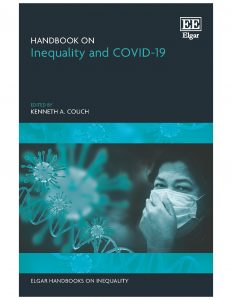
Edward Elgar Publishes Handbook on Inequality and COVID-19 Edited by Professor Couch

Book cover.In this comprehensive Handbook, Professor Kenneth Couch of the University of Connecticut, Department of Economics, brings together expert contributors to provide insights into the impact of COVID-19 on new and pre-existing inequalities in health, work, and education. While sharper impacts on pre-existing cross-group disparities were often resolved by vaccinations and the lifting of restrictions, this important work indicates that in many respects disadvantaged groups will endure lasting negative effects from the pandemic.

An interdisciplinary and international range of authors investigate disparities in mortality, healthcare spending, domestic violence, and mental health for people of different genders, ethnicities, immigration statuses, and age, providing novel contributions to post-pandemic scholarship and introducing innovative empirical research. They emphasize the effect of the pandemic on the labor market, including  the ramifications on minority and migrant employment and the gender-specific outcomes of working from home. The Handbook also underscores the negative and heterogeneous effects of the pandemic on school enrollment, student well-being, and academic performance across all school ages. Ultimately, this Handbook provides a detailed overview of contemporary post-pandemic research into inequality.

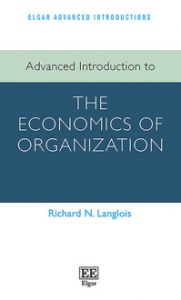
Professor Langlois Publishes Advanced Introduction to the Economics of Organization

Book Cover of Advanced Introduction to the Economics of OrganizationProfessor Langlois’s book Advanced Introduction to the Economics of Organization has been published in the Elgar Advanced Introduction series:
This incisive book presents a succinct overview of the economics of organization. Combining traditional approaches with more challenging, cutting-edge perspectives, Richard N. Langlois critically examines the ways in which tasks and transactions in the economy are organized.

Drawing on a diverse array of historical and real-world examples, chapters outline key principles of the field including division of labor, transaction costs, moral hazard, and asset specificity. This Advanced Introduction investigates ‘organization’ more broadly, delving into underexplored areas such as capabilities and routines, evolutionary selection, dynamic transaction costs, and modular systems.

Professor Kai Zhao to be published in Review of Economic Studies

Professor Kai Zhao’s paper, “How Important Is Health Inequality for Lifetime Earnings Inequality?” (with Roozbeh Hosseini and Karen Kopecky), has been accepted for publication in the Review of Economic Studies, one of the top five academic journals in Economics.

In this paper, Professor Zhao and his coauthors examine an often-overlooked driver of economic inequality: health disparities. They show that health inequality is not just a reflection of broader economic disparities but a key driver of them.

Abstract:

Using a dynamic panel approach, we provide empirical evidence that negative health shocks significantly reduce earnings. The effect is primarily driven by the participation margin and is concentrated among the less educated and those in poor health. Next, we develop a life cycle model of labor supply featuring risky and heterogeneous frailty profiles that affect individuals’ productivity, likelihood of access to social insurance, disutility from work, mortality, and medical expenses. Individuals can either work or not work and apply for social security disability insurance (SSDI/SSI). Eliminating health inequality in our model reduces the variance of log lifetime (accumulated) earnings by 28 percent at age 55. About 60 percent of this effect is due to the impact of poor health on the probability of obtaining SSDI/SSI benefits. Despite this, we show that eliminating the SSDI/SSI program reduces ex ante welfare.

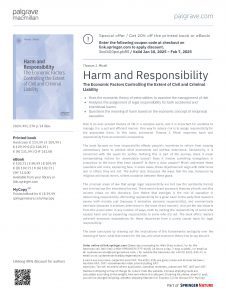
Professor Miceli Publishes Harm and Responsibility

Professor Thomas Miceli has published  Harm and Responsibility: The Economic Factors Controlling the Extent of Civil and Criminal Liability

From the publisher:

Risk is an ever-present feature of life in a complex world, and it is important for societies to manage it in a just and efficient manner. One way to reduce risk is to assign responsibility for the associated harm. In this book, economist Thomas J. Miceli examines harm and responsibility from an economic perspective.

The book focuses on how responsibility affects people’s incentives to refrain from causing unnecessary harm to achieve what economists call optimal deterrence. Secondarily, it is concerned with the quest for justice. Defining this is part of the journey. Does it mean compensating victims for unavoidable losses? Does it involve punishing wrongdoers in proportion to the harm they have caused? Is there a clear answer? The book addresses these questions and more, explaining how, in some cases, these objectives will align with deterrence and in others they will not. The book discusses the ways that the law, tempered by religious and social norms, strikes a balance between these goals.

The principal areas of law that assign legal responsibility are tort law (for accidental harms) and criminal law (for intentional harms). There exist vibrant economic theories of both, and this volume draws on this literature. One theme that emerges is the role of causation in determining responsibility. Attributing responsibility for a given harm to the party that caused it seems both morally just (because it embodies personal responsibility), and economically desirable (because it achieves deterrence in the most direct manner). And yet the law departs from this prescription in any number of ways, both by limiting the responsibility of some who caused harm and by expanding responsibility to some who did not. The book offers readers coherent economic explanations for these departures from a purely causal basis for legal responsibility.

Author Thomas J. Miceli clarifies causation as reciprocal in nature and therefore not a uniquely defined concept. This means that when an action by A causes harm to B, the question is not how to restrain A but rather: whether A has the legal right to take the action in question or whether B has the right to prevent it. There will be a harm either way; the relevant question is which party should bear it. This insight ultimately leads to the fundamental problem of defining harm. In most conflicts this can be straightforward—as when A punches B—but in others it is more challenging. For example, when does free speech become hate speech? Where is the line drawn?

The book concludes by drawing out the implications of this fundamental ambiguity over the meaning of harm, what that means for the law, and what economic theory has to say about it.

https://link.springer.com/book/10.1007/978-3-031-74831-8