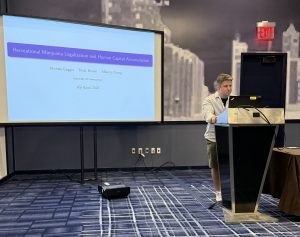
 Members of the Department of Economics recently presented their research at the 2026 Conference of the American Society of Health Economists (ASHEcon), held in Minneapolis, MN.
PhD candidate Matt Brown presented “Recreational Marijuana Legalization and Human Capital Accumulation” (coauthored with Professor Baggio and Alberto Chong, Georgia State University). The paper examines how recreational marijuana legalization has affected educational outcomes in the United States. The paper shows that legalization reduced the share of young adults obtaining a GED-or-higher educational attainment and lowered middle school test scores. The study also finds evidence that these laws reduced parental investments in children, as measured by parental time with children, home environment, and cases of child maltreatment.
Professor Ritter presented two papers. The first, “Does Early-Life Medicaid Protect Against Pandemic Mortality? Evidence from COVID-19” (coauthored with Michael DiNardi, a 2018 graduate of UConn’s Economics PhD program and current faculty member at the University of Rhode Island), examines whether childhood Medicaid eligibility improved resilience to later-life mortality shocks. Using mortality data from 2010–2022 and variation from the staggered rollout of Medicaid across states, the paper shows that each additional year of Medicaid eligibility at ages 0–5 reduced adult mortality substantially, with similar effects before and during COVID-19, no significant effects for eligibility at older ages, and a narrowing of racial mortality disparities.
The second paper, “Twice Unlucky: The Interaction of Early-Life Cholera and Adult COVID-19 on Mortality” (with Ricardo Sanchez, Barcelona School of Economics), investigates whether prenatal exposure to Peru’s 1991 cholera epidemic increased vulnerability to COVID-19 mortality decades later. Combining cholera, mortality, and survey data in a quasi-experimental framework, the authors find that greater first-trimester cholera exposure increased COVID-19 mortality among working-age women.
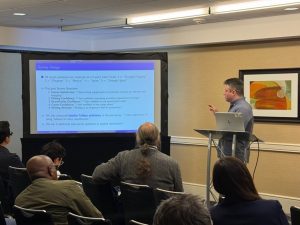 The presentation examined the integration of Tableau-based data visualization into a required undergraduate economics writing course. Using pre- and post-course survey data, the study finds improvements in student course satisfaction and writing confidence after students learned to produce their own data visualizations. The results highlight the potential for combining data literacy and writing instruction to enhance student engagement and communication skills in economics coursework.
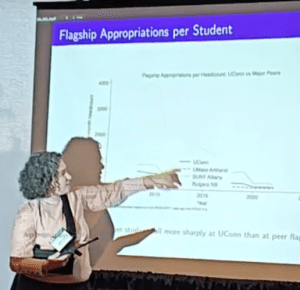 Edlira Cocoli (PhD candidate) presented “Economic Shock and State Support for Higher Education: Evidence from the Northeastern U.S. Using Shift Share Identification” at the Annual Conference of the Southern Economic Association in November.