Faculty

UConn at ASHEcon

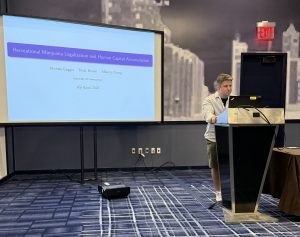
Matthew Brown at ASHEcon26Members of the Department of Economics recently presented their research at the 2026 Conference of the American Society of Health Economists (ASHEcon), held in Minneapolis, MN.
PhD candidate Matt Brown presented “Recreational Marijuana Legalization and Human Capital Accumulation” (coauthored with Professor Baggio and Alberto Chong, Georgia State University). The paper examines how recreational marijuana legalization has affected educational outcomes in the United States. The paper shows that legalization reduced the share of young adults obtaining a GED-or-higher educational attainment and lowered middle school test scores. The study also finds evidence that these laws reduced parental investments in children, as measured by parental time with children, home environment, and cases of child maltreatment.

Professor Ritter presented two papers. The first, “Does Early-Life Medicaid Protect Against Pandemic Mortality? Evidence from COVID-19” (coauthored with Michael DiNardi, a 2018 graduate of UConn’s Economics PhD program and current faculty member at the University of Rhode Island), examines whether childhood Medicaid eligibility improved resilience to later-life mortality shocks. Using mortality data from 2010–2022 and variation from the staggered rollout of Medicaid across states, the paper shows that each additional year of Medicaid eligibility at ages 0–5 reduced adult mortality substantially, with similar effects before and during COVID-19, no significant effects for eligibility at older ages, and a narrowing of racial mortality disparities.

The second paper, “Twice Unlucky: The Interaction of Early-Life Cholera and Adult COVID-19 on Mortality” (with Ricardo Sanchez, Barcelona School of Economics), investigates whether prenatal exposure to Peru’s 1991 cholera epidemic increased vulnerability to COVID-19 mortality decades later. Combining cholera, mortality, and survey data in a quasi-experimental framework, the authors find that greater first-trimester cholera exposure increased COVID-19 mortality among working-age women.

Professor Furtado in UConn Today: Impacts of Immigration on Nursing Home Care

Professor Delia Furtado is featured in the current issue of UConn Today:

UConn Professor Examines Impacts of Immigration on Nursing Home Care

Study finds that local immigration reduces mortality and improves quality of life for nursing home residents

The United States is on the brink of a crisis in elder care. Reports of an aging population have not been exaggerated – it is no longer the case that a relatively small population of older adults can be supported physically and financially by a much larger population of working adults. Thanks to both the Baby Boom and lifespan-enhancing advances in medicine, these groups are now more similar in size. 

Where does that leave older adults today – especially those who struggle with ADLs, or activities of daily living? 

Many older adults are cared for in nursing homes. These facilities are exorbitantly expensive (the average yearly price for a private room in a nursing home in Connecticut exceeds $200,000, according to CareScout) and often understaffed.

professional headshot“You’d think that with that amount of money, staying in a nursing home should be like staying in a five-star hotel, but no,” says Delia Furtado, professor of economics.

Furtado is interested in how an unexpected variable – immigration — may impact the quality of care that nursing home residents receive. 

“I’ve been working on immigration my entire career — over 20 years now,” says Furtado. Her previous research has explored the assimilation process of immigrants and their impacts on the native population via their work in childcare and housekeeping. 

Furtado’s recently published research in the Journal of Human Resources found that when more people immigrate to a certain geographic area, it leads to better care outcomes for nursing home residents in that area...

Read the full article at UConn Today:

UConn Professor Examines Impacts of Immigration on Nursing Home Care

Spotlight on Alumni: Nicholas Jolly, PhD ’08, Promoted to Full Professor

Nicholas (Nick) Jolly, PhD ’08, was recently promoted to full professor of economics at Marquette University, effective beginning in the 2026–27 academic year. A labor economist, his research focuses on the labor market outcomes and adjustment processes of workers who experience involuntary job separations and work-limiting disabilities. He has also published research on collective bargaining agreements in professional sports.

Although nearly two decades have passed since Nick defended his dissertation, he remains closely connected to the department. Most recently, he coauthored a paper with Professor Delia Furtado in the Oxford Review of Economic Policy examining how immigrant labor may help address eldercare worker shortages in the United States. He also contributed, with several coauthors, a chapter on regional variation in COVID-19 vaccination rates to the Handbook on Inequality and COVID-19, edited by Professor Ken Couch.

Nick remains a devoted Huskies fan. He regularly returns to Connecticut during the summer to visit family and can often be spotted in the UConn Bookstore restocking his Husky gear. During his visits, he typically stops by the department and is always generous with his time meeting current PhD students and faculty. If you would like to connect with Nick — or simply congratulate him on his promotion — feel free to reach out to him.

To our other UConn economics alumni: if you have exciting career news to share, please contact economics@uconn.edu. We would love to hear from you.

Professor Vidart Appointed NBER Research Fellow

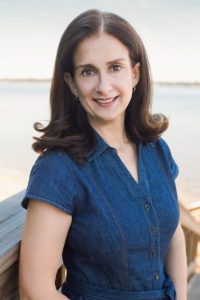
professional headshotProfessor Daniela Vidart has been named a Faculty Research Fellow in the Development of the American Economy Program of the National Bureau of Economic Research (NBER).

https://www.nber.org/people/daniela_vidart

The Development of the American Economy Program “explores the sources of long-run growth and fluctuations in the US economy. It considers the contributions of human and physical capital, as well as the role of public policy.”

Professor Vidart’s research bridges macroeconomics and economic history to study human capital accumulation and its impacts on labor market outcomes and economic growth.

Economics Faculty Sung Hoon Choi and Patricia Ritter Receive Promotions

Congratulations to Economics faculty Sung Hoon Choi, who has received promotion to tenured Associate Professor, and Patricia Ritter, promoted to Associate Professor in Residence!

The UConn Board of Trustees approved the promotions, effective August 23rd, at the Board meeting on Wednesday, April 29th.

UConn Celebrates Promotion and Tenure of Faculty for 2026

MSQE Panel Highlights AI Careers for Students

On April 6, the Economics Department’s Master of Science in Quantitative Economics (MSQE) program hosted a panel for current and prospective students interested in careers in the AI industry. The event offered students an opportunity to learn more about the program and the kinds of professional paths it can open.

Panelists emphasized that the MSQE program provides rigorous training in quantitative skills such as Python, data analysis, and econometrics. Just as important, however, is the program’s grounding in economic theory and its application to real-world problems. The speakers noted that one of the most valuable skills students develop is the ability to frame a problem clearly and design thoughtful solutions.

The panel also highlighted that technical expertise alone is not enough. What often distinguishes strong candidates is the ability to tell a clear story about the data or model and to communicate insights effectively to different audiences. In today’s workplace, being able to translate technical analysis into practical understanding is a major advantage.

The panelists were optimistic about AI and its impact on their work. They described AI as a tool that increases productivity and helps them take on problems outside their immediate technical expertise. By combining strong problem framing with AI-assisted tools, professionals can develop solutions more quickly and more creatively.

When discussing what sets job candidates apart, the panelists pointed to several qualities: a sophisticated understanding of technical tools, grit in tackling challenging problems, friendliness, and humility. Together, these traits help candidates stand out in a competitive and fast-changing field.

Panelists

  • Christopher J. Daigle, Associate Vice President (AVP) of AI & Automation Engineering at Arch Capital, MSQE 2018
  • Sean Ippolito, Senior Data Scientist for Identity & Fraud Services, Equifax
  • Neal Coleman, PhD, Data Scientist and Director of Emerging Sciences, The Hartford
  • Moderator: Oskar Harmon, Associate Professor of Economics

If you missed this panel, there will be more opportunities in the future. We look forward to hosting additional panels that connect students with professionals working at the forefront of AI and quantitative economics.

Trumbull High School Students Visit Stamford

Students enrolled in the Early College Experience (ECE) Economics courses at Trumbull High School visited the Stamford campus on Thursday, March 26, 2026. Forty-five students and three ECE Economics instructors arrived in the early morning hours to take part in the extensive “Day at UConn Stamford” event. Many of those students are accepted to the University of Connecticut and plan to enroll in the Fall.

Trumbull High School students and their ECE Economics teachers at Stamford, March 26, 2026

Stamford Campus Dean, Dr. Jennifer E. Orlikoff, welcomed the group and set them up for an activity-packed day, which included the campus tour, career panel discussion, and attendance of an Economics class.

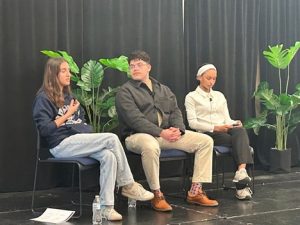
Career panelists, from left to right, Liz Maia (’26), Kothan Nieves-Orama (’27), and Alexys Willaims (’27) answering questions from the audience.

Career panel was moderated by Tara Malone, Director of the Center for Career Development at Stamford. Three Economics majors shared their experience of obtaining internships and jobs with the help of Career Fairs and Career Center events and services. The students, Liz Maia (’26), Kothan Nieves-Orama (’27), and Alexys Williams (’27), talked about the applicability of the Economics major to the broad job market. They answered high school students’ questions about the strategies to be employed at the undergraduate level to secure a job upon graduation. “It is not too early to engage in your career exploration and utilize many resources available on campus to aid you in this endeavor” was the overall message.

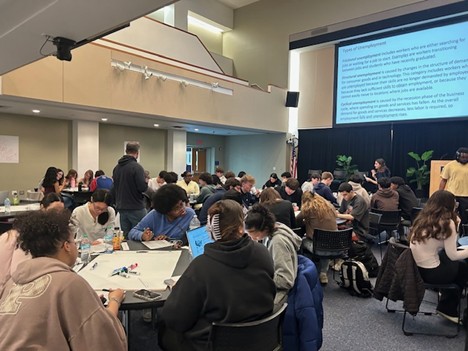
Students attended Dr. Knoblauch’s “Industrial Organization” class and Dr. Smirnova’s “Principles of Macroeconomics” class. Both classes were engaging and interactive. Trumbull students were able to join forces with UConn students on various tasks and learn not only the economics material, but also teamwork and communication skills. These competencies are at the heart of Economics students’ preparation for successful careers. Trumbull school Economics instructors, Mr. Brian Sprinsteen, Mr. Martin McGrath, and Mr. Gregg Basbagill, commented that UConn students were leading the collaborative work during the exercises and were enthusiastically mentoring high schoolers.

Events like this support the outreach mission of the University and promote cooperative spirit between UConn and the local community.

Trumbull High School students working collaboratively with Dr. Smirnova’s students during ECON 1202 Principles of Macroeconomics class on March 26, 2026.
Trumbull High School students working collaboratively with Dr. Smirnova’s students during ECON 1202 Principles of Macroeconomics class on March 26, 2026


Professor Smirnova Accepted to the Fulbright Specialist Program

Professor Natalia Smirnova is accepted to the Fulbright Specialist Program, which was established in 2001 as part of the larger Fulbright Program.

A program of the U.S. Department of State, Bureau of Educational and Cultural Affairs, the Fulbright Specialist Program is a unique opportunity for U.S. academics and established professionals to engage in two- to six-week collaborative projects at institutions across the globe. By participating in the program, U.S. academics and professionals share their expertise, strengthen their home institutions by partnering with overseas counterparts, hone their skills, gain international experience, and learn about other cultures while building capacity at their foreign institutions.

Dr. Smirnova plans to engage educational institutions around the world in building a more informed citizenry and a better prepared labor force. She is excited to offer a variety of training activities, such as a series of seminars, master classes, and professional development workshops focused on economic education, financial literacy, and career readiness. At this stage, she is looking for an international partner to deliver proposed projects.

Dr. Smirnova will remain on the Fulbright Specialist roster until 2029.

Recent Publications by Professor Baggio and Professor Coşgel

Professor Michele Baggio has a paper published in Economics Letters:

Baggio M., Suryanarayana R., and S. Uchida. 2026. Heat and Hate: How Temperature Triggers Discriminatory ViolenceEconomics Letters. Vol. 261: article 112861.

And Professor Baggio and Professor Metin Coşgel have a paper forthcoming in Journal of Law, Economics, and Organization:

Baggio M. and M. Coşgel. 2026. Racial Diversity and Team Performance: Evidence from the American Offshore Whaling Industry. Forthcoming in Journal of Law, Economics, and Organization