Web cookies (also called HTTP cookies, browser cookies, or simply cookies) are small pieces of data that websites store on your device (computer, phone, etc.) through your web browser. They are used to remember information about you and your interactions with the site.
Purpose of Cookies:
Session Management:
Keeping you logged in
Remembering items in a shopping cart
Saving language or theme preferences
Personalization:
Tailoring content or ads based on your previous activity
Tracking & Analytics:
Monitoring browsing behavior for analytics or marketing purposes
Types of Cookies:
Session Cookies:
Temporary; deleted when you close your browser
Used for things like keeping you logged in during a single session
Persistent Cookies:
Stored on your device until they expire or are manually deleted
Used for remembering login credentials, settings, etc.
First-Party Cookies:
Set by the website you're visiting directly
Third-Party Cookies:
Set by other domains (usually advertisers) embedded in the website
Commonly used for tracking across multiple sites
Authentication cookies are a special type of web cookie used to identify and verify a user after they log in to a website or web application.
What They Do:
Once you log in to a site, the server creates an authentication cookie and sends it to your browser. This cookie:
Proves to the website that you're logged in
Prevents you from having to log in again on every page you visit
Can persist across sessions if you select "Remember me"
What's Inside an Authentication Cookie?
Typically, it contains:
A unique session ID (not your actual password)
Optional metadata (e.g., expiration time, security flags)
Analytics cookies are cookies used to collect data about how visitors interact with a website. Their primary purpose is to help website owners understand and improve user experience by analyzing things like:
How users navigate the site
Which pages are most/least visited
How long users stay on each page
What device, browser, or location the user is from
What They Track:
Some examples of data analytics cookies may collect:
Page views and time spent on pages
Click paths (how users move from page to page)
Bounce rate (users who leave without interacting)
User demographics (location, language, device)
Referring websites (how users arrived at the site)
Here’s how you can disable cookies in common browsers:
1. Google Chrome
Open Chrome and click the three vertical dots in the top-right corner.
Go to Settings > Privacy and security > Cookies and other site data.
Choose your preferred option:
Block all cookies (not recommended, can break most websites).
Block third-party cookies (can block ads and tracking cookies).
2. Mozilla Firefox
Open Firefox and click the three horizontal lines in the top-right corner.
Go to Settings > Privacy & Security.
Under the Enhanced Tracking Protection section, choose Strict to block most cookies or Custom to manually choose which cookies to block.
3. Safari
Open Safari and click Safari in the top-left corner of the screen.
Go to Preferences > Privacy.
Check Block all cookies to stop all cookies, or select options to block third-party cookies.
4. Microsoft Edge
Open Edge and click the three horizontal dots in the top-right corner.
Go to Settings > Privacy, search, and services > Cookies and site permissions.
Select your cookie settings from there, including blocking all cookies or blocking third-party cookies.
5. On Mobile (iOS/Android)
For Safari on iOS: Go to Settings > Safari > Privacy & Security > Block All Cookies.
For Chrome on Android: Open the app, tap the three dots, go to Settings > Privacy and security > Cookies.
Be Aware:
Disabling cookies can make your online experience more difficult. Some websites may not load properly, or you may be logged out frequently. Also, certain features may not work as expected.
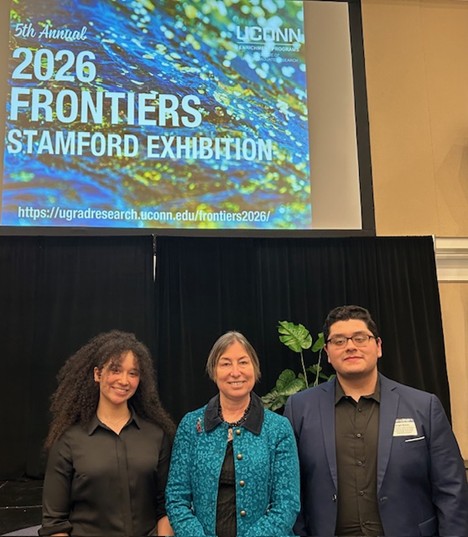
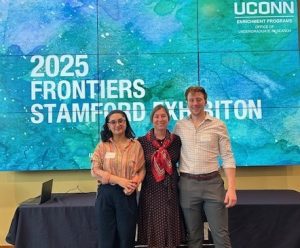
The Frontiers in Undergraduate Research Exhibition was held at the Stamford campus on Tuesday, April 21, 2026. Two Economics students, Isabella Thomas (’27) and Angel Bravo (’26), presented their applied research on macroeconomic growth models. Isabella compared the growth trajectories of Venezuela and Brazil, while Angel explored factors that influence Columbia’s and Switzerland’s economic development. The research adviser for these projects is Dr. Smirnova.
The 2026 Frontiers Exhibition drew 25 participants, which showed a great diversity of topics and fields of study. Stamford Economics students participate in the Frontiers conference every year showcasing their rigorous quantitative skills, presentation competencies, and professionalism. This year, Dr. Smirnova’s “Money and Banking” class attended the conference displaying their interest in the undergraduate research opportunities and supporting their peers.
Isabella Thomas (’27), Dr. Smirnova, Economics faculty, Angel Bravo (’26) at the Frontiers in Undergraduate Research Exhibition in Stamford on April 21, 2026
On April 6, the Economics Department’s Master of Science in Quantitative Economics (MSQE) program hosted a panel for current and prospective students interested in careers in the AI industry. The event offered students an opportunity to learn more about the program and the kinds of professional paths it can open.
Panelists emphasized that the MSQE program provides rigorous training in quantitative skills such as Python, data analysis, and econometrics. Just as important, however, is the program’s grounding in economic theory and its application to real-world problems. The speakers noted that one of the most valuable skills students develop is the ability to frame a problem clearly and design thoughtful solutions.
The panel also highlighted that technical expertise alone is not enough. What often distinguishes strong candidates is the ability to tell a clear story about the data or model and to communicate insights effectively to different audiences. In today’s workplace, being able to translate technical analysis into practical understanding is a major advantage.
The panelists were optimistic about AI and its impact on their work. They described AI as a tool that increases productivity and helps them take on problems outside their immediate technical expertise. By combining strong problem framing with AI-assisted tools, professionals can develop solutions more quickly and more creatively.
When discussing what sets job candidates apart, the panelists pointed to several qualities: a sophisticated understanding of technical tools, grit in tackling challenging problems, friendliness, and humility. Together, these traits help candidates stand out in a competitive and fast-changing field.
Panelists
Christopher J. Daigle, Associate Vice President (AVP) of AI & Automation Engineering at Arch Capital, MSQE 2018
Sean Ippolito, Senior Data Scientist for Identity & Fraud Services, Equifax
Neal Coleman, PhD, Data Scientist and Director of Emerging Sciences, The Hartford
Moderator: Oskar Harmon, Associate Professor of Economics
If you missed this panel, there will be more opportunities in the future. We look forward to hosting additional panels that connect students with professionals working at the forefront of AI and quantitative economics.
Heather’s career includes 30 years of experience in for-profit, nonprofit, and public service organizations. Prior to joining the New York Fed in 2015, Heather was the Senior Director of Executive MBA Admissions at New York University Stern School of Business. Before transitioning into education, she led Network Solutions Group Strategy & Planning at Lucent Technologies (now Nokia Bell Labs). She has also taught micro- and macroeconomics as an adjunct professor for the Bard Prison Initiative, working with students at NYS Eastern Correctional Facility.
Heather Daly, Head of Economic Education, Community Development & Education, Communications and Outreach Group, Federal Reserve Bank of New York
Heather earned a Bachelor of Arts and Master of Arts in Political Science from the University of Connecticut, as well as a Master of Business Administration degree from New York University.
At Stamford on February 17, 2026, Ms. Daly presented a talk “Introduction to the Federal Reserve System”, where she took an in-depth look into the history of U.S. Central Banks and the Federal Reserve System. The discussion with students focused on the structure and functions of the Federal Reserve System, and current intricacies of Federal Reserve Board and Federal Open Market Committee (FOMC).
The second focus of Ms. Daly’s presentation was on students’ career preparation. Heather outlined skills and competencies that are needed at the Fed and explained the timeline for opportunities for internships and programs open for various levels of academic preparation.
This unique event, where several Economics classes came together, was conceived and organized by the Economics Research and Policy Council (a.k.a. The Economics Club) in Stamford with support from the Economics Department, its faculty Dr. Couch, and faculty Club Adviser, Dr. Smirnova.
We are grateful to Ms. Daly for coming to campus, sharing her knowledge and expertise, her career “learning journey”, and UConn alumna’s wisdom with Economics students at Stamford.
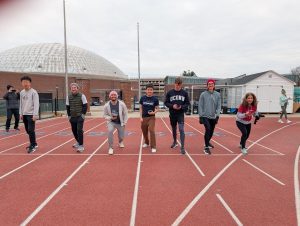
Neither final exams nor frigid temperatures stopped faculty and PhD students from running theEcon5Ktogether this past Saturday. Proof that economists don’t only run regressions! The winners will be announced online in early January during the ASSA meetings. We wish our athletes luck! Go Huskies!
The categories for winners:
– Top three finishers (by gender identity)
– Top three finishers age-adjusted (by gender identity)
– Top finisher by continent (by gender identity)
– Greatest elevation change (+/-)
– Highest starting elevation
– Highest/lowest temperature
– The Beauty contest winner for whoever is closest to the average time
– Top three empiricists (by gender identity)
– Top three theorists (by gender identity)
– Top three microeconomists (by gender identity)
– Top three macroeconomists (by gender identity)
– Fastest run with a dog
– Fastest run with a stroller (and occupant!)
– Streak award for the longest streak of consecutive 5Ks in December
– Run that is most outstanding in terms of artistic merit (with route captured on Strava or similar app)
– Largest group of economists running together
Two Economics students, Madina Mamedli and Cole Sembrot presented their research at the Frontiers in Undergraduate Research Exhibition in Stamford on April 22, 2025. Their academic adviser is Professor Smirnova.
Madina Mamedli presenting her research
Madina’s paper was entitled “From Chalk to Checkbooks: The Real Price of Educational Inequality”. Madina compared the investment in and the outcomes of public and private secondary education institutions in the U.S. Her literature review and regression analysis revealed inadequate funding for public schools, which leads to lower SAT scores, lower college counselor / student ratio, and other disadvantages for students attending public schools. Madina concluded that educational inequality transforms early life privileged into long-term economic advantage. Disparities in school resources, academic support, and access to college counseling directly shape earning potential.
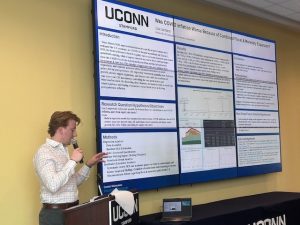
Cole Sembrot presenting his research
Cole Sembrot discerned fiscal and monetary policies’ impacts on the economy during the pandemic. His paper was entitled “Was COVID Inflation Worse Because of Combined Fiscal and Monetary Expansion?” Cole has built the regression model that examines how much post-COVID inflation is due to the actions of the Federal Reserve: near zero interest rates, QE, balance sheet expansion, and money supply growth, while controlling for supply-side shock. Cole concluded that the post-pandemic inflationary episode is due to a complex interplay between policy and external economic shocks.
Madina Mamedli (’25), Dr. Smirnova, Cole Sembrot (’25)
The event was attended by more than 50 people: students, faculty, and staff. There were guests from the Office of Undergraduate Research and UConn Enrichment Programs as well as Stamford campus administration. The atmosphere of the event was academic in nature, but friendly and supportive. 20 students from various fields of study presented their research results. Experiences like this help students gain confidence and prepare for careers upon graduation.
During the trip to the Open House at the Federal Reserve Board, UConn-Stamford 2024 Team of the College Fed Challenge competition had an opportunity to meet with UConn alum, Misbah Seyal. Mr. Seyal is a real estate professional with a substantive career including various positions at Moody’s, Wells Fargo, Bank of America, and other financial services firms.
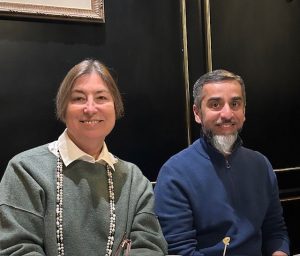
Natalia Smirnova, faculty, (left) and Misbah Seyal, UConn alum (BA’97, MBA’04), at dinner with students on February 6, 2025, in Washington, DC.
During the meeting with students, Misbah talked about career opportunities after graduation from UConn. He emphasized the importance of developing skills that could be transferred to the workplace and of being adaptable to labor market conditions as they change.
Students were interested in learning about the real estate sector as well as about the financial sector. They were curious about navigating the competitive market environment and about balancing career expectations and family. Misbah shared his wisdom and encouraged students to pursue their passions and dreams.
The students, as well as Dr. Smirnova, faculty adviser to the College Fed Challenge team, are grateful to Mr. Seyal for his time with us. We are also appreciative of Ms. Siobhan Lidington, Director of Development, School of Business, University of Connecticut Foundation, for her efforts to make this meeting possible.
ECE Economics workshop participants in Storrs on October 23, 2024
The Early College Experience – Economics program is the largest at UConn. In the Economics program, we have 34 partner high schools with 66 certified economics instructors. Last academic year, 1,102 students were enrolled in 68 economics courses, with a total enrollment of 1,607 students. Our program is making a meaningful impact on Connecticut students introducing them to economic concepts and way of thinking as well as preparing them for college attendance.
Every year, Dr. Smirnova, who is ECE Economics coordinator, conducts the professional development workshop for participating teachers. The workshop is aimed at providing comparability of instruction and at sharing pedagogical innovations.
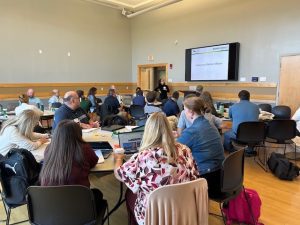
This year, 23 teachers from partner schools attended the workshop on October 23. The room was buzzing with commotion as guest speakers engaged the audience with hands-on activities.
Our guest speakers were Ariel Slonim, Curriculum Designer at Marginal Revolution University (MRU) and Mary Clare Peate, Senior Economic Education Specialist at Federal Reserve Bank of St. Louis.
The micro- and macroeconomics concepts were showcased in interactive ways, that would encourage high school students to engage in the classroom. Here are the topics:
Learning about Economic Decision Making with Pretzels
Cowbells and M&Ms: Creative Classroom Exercises for Teaching Externalities and Public Goods
The Inflation Rate is Falling, but Prices are Not!
Fact vs. Fiction: Interactive Tools to Teach the Truth About Fiscal Policy
This year, the teachers also heard from their peer, Ms. Lynn Taillon from Cheshire High School. Ms. Taillon shared her “Valentine’s Day” and “Model Decorations for Christmas” activities. Such sharing stimulated the discussion of other ideas and stories of attending teachers.
Participants went away with a lot of pedagogical materials that could be used immediately in their classrooms. All materials are stored on HuskyCT in the ECE Economics organization section.
On July 1 and 2, the Department of Economics hosted the annual New England Experimentalist Workshop.
The Workshop brought together experimental and behavioral economists from twelve universities to present research on topics as diverse as gender pay disparities, self-censorship of political views in the classroom, and effective environmental policy.
The two-day workshop was organized by faculty members Remy Levin and Mike Shor and graduate student Anastassiya Karaban.
Mara Gauger (’13) at the Stamford campus on April 9, 2024
Students in Professor Smirnova’s Financial Economics and Money and Banking classes were visited by UConn Alumna, Mara Gauger (’13) on Tuesday, April 9, 2024.
Mara Gauger graduated from UConn with BA degree in Economics in 2013. After graduation, she worked at Citi, and achieved the level of Assistant Vice President. Since 2016 she works at Deloitte.
Mara Gauger is currently a Senior Manager Deloitte’s Capital Markets practice with extensive experience supporting securities firms and broker-dealers. Mara focuses on assisting firms on topics related to securities operations, trading systems, and risk management programs. At Deloitte, Mara has been a lead in the SEC Rule 613 Consolidated Audit Trail project office as well as assisting firms in their design and implementation of the rule requirements. Mara is also a core member of the Deloitte team supporting SIFMA, ICI, and DTCC’s efforts to analyze the impacts of an accelerated settlement cycle (T+1) since inception.
The goal of Mara’s visit was to familiarize students with careers in the financial sector, and mentor them on how to get their first job upon graduation from UConn with the Economics degree. Mara generously shared her wisdom about how to navigate the process of job and internship search: what to showcase on the resume to stand out; how to network through LinkedIn and HuskyLink; how to prepare for and conduct interviews; how to utilize the Career Center and Career Fairs; and what skills and career competencies are in demand in the marketplace.
Students were able to ask questions pertaining to their career aspirations and their experiences with internships and job search. Students who are seniors were the most vocal and were able to ask the most pointed and specific questions. Students who are juniors and sophomores received a motivational advice to start their networking as early as possible. Mara suggested utilizing HuskyLink as the first step of connecting with the UConn alumni.
Mara Gauger (’13) (right) and Dr. Smirnova at the Stamford campus on April 9, 2024
Mara shared that her visit to UConn is the way to give back to her Alma Mater after working in the financial industry for 10 years. She was very supportive of students’ inquiries and honest about identifying the competitiveness of the industry and challenges of getting the first job out of college. Students took her advice and candid conversation in stride. They were encouraged by Mara to continue their studies, gain career competencies, and confidently showcase their strengths and skills to the employers.
Thank you, Mara Gauger (’13) for visiting us at UConn Stamford. We really appreciate it!
UConn-Stamford students at the Women in Economics Symposium Watch Party, April 4, 2024
UConn-Stamford was an official Watch Party for the Women in Economics Symposium 2024. The Symposium’s goal is to showcase the role of women in Economics profession and inspire students to pursue majors and careers in Economics.
This year, the agenda included interesting conversations about careers with BA and MA degrees, about getting the first job, and the keynote address by the newest Governor of the Federal Reserve Board, Adriana Kugler.
Stamford students enjoyed the discussion about economics’ role in their career preparation, interactive activities provided by the organizers, togetherness, and camaraderie. And, of course, pizza and cookies provided by the Honors Program.
Jonathan was on hand to provide additional spiritual support!