Web cookies (also called HTTP cookies, browser cookies, or simply cookies) are small pieces of data that websites store on your device (computer, phone, etc.) through your web browser. They are used to remember information about you and your interactions with the site.
Purpose of Cookies:
Session Management:
Keeping you logged in
Remembering items in a shopping cart
Saving language or theme preferences
Personalization:
Tailoring content or ads based on your previous activity
Tracking & Analytics:
Monitoring browsing behavior for analytics or marketing purposes
Types of Cookies:
Session Cookies:
Temporary; deleted when you close your browser
Used for things like keeping you logged in during a single session
Persistent Cookies:
Stored on your device until they expire or are manually deleted
Used for remembering login credentials, settings, etc.
First-Party Cookies:
Set by the website you're visiting directly
Third-Party Cookies:
Set by other domains (usually advertisers) embedded in the website
Commonly used for tracking across multiple sites
Authentication cookies are a special type of web cookie used to identify and verify a user after they log in to a website or web application.
What They Do:
Once you log in to a site, the server creates an authentication cookie and sends it to your browser. This cookie:
Proves to the website that you're logged in
Prevents you from having to log in again on every page you visit
Can persist across sessions if you select "Remember me"
What's Inside an Authentication Cookie?
Typically, it contains:
A unique session ID (not your actual password)
Optional metadata (e.g., expiration time, security flags)
Analytics cookies are cookies used to collect data about how visitors interact with a website. Their primary purpose is to help website owners understand and improve user experience by analyzing things like:
How users navigate the site
Which pages are most/least visited
How long users stay on each page
What device, browser, or location the user is from
What They Track:
Some examples of data analytics cookies may collect:
Page views and time spent on pages
Click paths (how users move from page to page)
Bounce rate (users who leave without interacting)
User demographics (location, language, device)
Referring websites (how users arrived at the site)
Here’s how you can disable cookies in common browsers:
1. Google Chrome
Open Chrome and click the three vertical dots in the top-right corner.
Go to Settings > Privacy and security > Cookies and other site data.
Choose your preferred option:
Block all cookies (not recommended, can break most websites).
Block third-party cookies (can block ads and tracking cookies).
2. Mozilla Firefox
Open Firefox and click the three horizontal lines in the top-right corner.
Go to Settings > Privacy & Security.
Under the Enhanced Tracking Protection section, choose Strict to block most cookies or Custom to manually choose which cookies to block.
3. Safari
Open Safari and click Safari in the top-left corner of the screen.
Go to Preferences > Privacy.
Check Block all cookies to stop all cookies, or select options to block third-party cookies.
4. Microsoft Edge
Open Edge and click the three horizontal dots in the top-right corner.
Go to Settings > Privacy, search, and services > Cookies and site permissions.
Select your cookie settings from there, including blocking all cookies or blocking third-party cookies.
5. On Mobile (iOS/Android)
For Safari on iOS: Go to Settings > Safari > Privacy & Security > Block All Cookies.
For Chrome on Android: Open the app, tap the three dots, go to Settings > Privacy and security > Cookies.
Be Aware:
Disabling cookies can make your online experience more difficult. Some websites may not load properly, or you may be logged out frequently. Also, certain features may not work as expected.
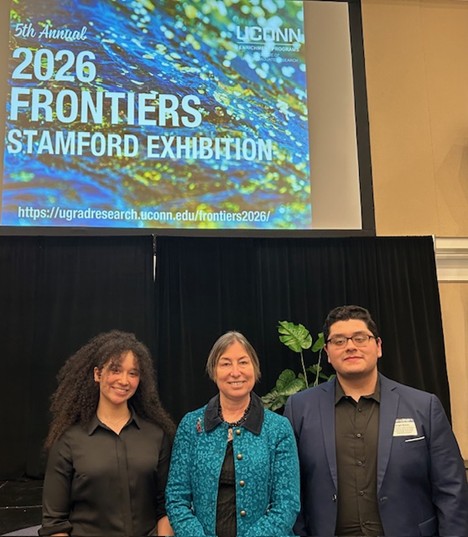
The Frontiers in Undergraduate Research Exhibition was held at the Stamford campus on Tuesday, April 21, 2026. Two Economics students, Isabella Thomas (’27) and Angel Bravo (’26), presented their applied research on macroeconomic growth models. Isabella compared the growth trajectories of Venezuela and Brazil, while Angel explored factors that influence Columbia’s and Switzerland’s economic development. The research adviser for these projects is Dr. Smirnova.
The 2026 Frontiers Exhibition drew 25 participants, which showed a great diversity of topics and fields of study. Stamford Economics students participate in the Frontiers conference every year showcasing their rigorous quantitative skills, presentation competencies, and professionalism. This year, Dr. Smirnova’s “Money and Banking” class attended the conference displaying their interest in the undergraduate research opportunities and supporting their peers.
Isabella Thomas (’27), Dr. Smirnova, Economics faculty, Angel Bravo (’26) at the Frontiers in Undergraduate Research Exhibition in Stamford on April 21, 2026
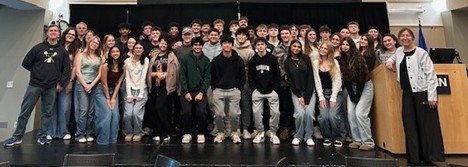
Students enrolled in the Early College Experience (ECE) Economics courses at Trumbull High School visited the Stamford campus on Thursday, March 26, 2026. Forty-five students and three ECE Economics instructors arrived in the early morning hours to take part in the extensive “Day at UConn Stamford” event. Many of those students are accepted to the University of Connecticut and plan to enroll in the Fall.
Trumbull High School students and their ECE Economics teachers at Stamford, March 26, 2026
Stamford Campus Dean, Dr. Jennifer E. Orlikoff, welcomed the group and set them up for an activity-packed day, which included the campus tour, career panel discussion, and attendance of an Economics class.
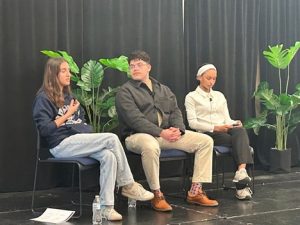
Career panelists, from left to right, Liz Maia (’26), Kothan Nieves-Orama (’27), and Alexys Willaims (’27) answering questions from the audience.
Career panel was moderated by Tara Malone, Director of the Center for Career Development at Stamford. Three Economics majors shared their experience of obtaining internships and jobs with the help of Career Fairs and Career Center events and services. The students, Liz Maia (’26), Kothan Nieves-Orama (’27), and Alexys Williams (’27), talked about the applicability of the Economics major to the broad job market. They answered high school students’ questions about the strategies to be employed at the undergraduate level to secure a job upon graduation. “It is not too early to engage in your career exploration and utilize many resources available on campus to aid you in this endeavor” was the overall message.
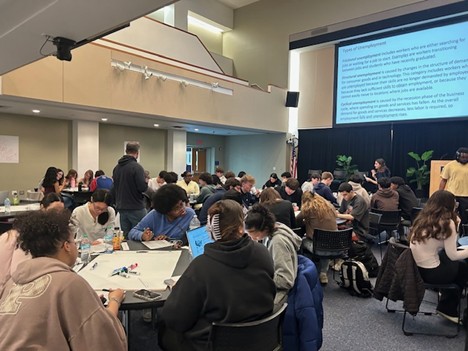
Students attended Dr. Knoblauch’s “Industrial Organization” class and Dr. Smirnova’s “Principles of Macroeconomics” class. Both classes were engaging and interactive. Trumbull students were able to join forces with UConn students on various tasks and learn not only the economics material, but also teamwork and communication skills. These competencies are at the heart of Economics students’ preparation for successful careers. Trumbull school Economics instructors, Mr. Brian Sprinsteen, Mr. Martin McGrath, and Mr. Gregg Basbagill, commented that UConn students were leading the collaborative work during the exercises and were enthusiastically mentoring high schoolers.
Events like this support the outreach mission of the University and promote cooperative spirit between UConn and the local community.
Trumbull High School students working collaboratively with Dr. Smirnova’s students during ECON 1202 Principles of Macroeconomics class on March 26, 2026
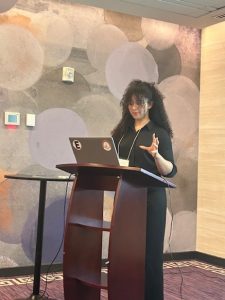
Isabella Thomas (’27) presents at the IPE conference, NYC, February 27, 2026
Two Economics undergraduate students from the Stamford campus, Isabella Thomas (’27) and Angel Bravo (’26), presented their research at the Issues in Political Economy conference in New York City on February 27, 2026. The agenda featured 43 student presentations from 20 academic institutions from all over the United States. As per the academic conference style, Isabella and Angel also were assigned as discussants for the research papers of other students. They gained the full experience of the professional economics conference.
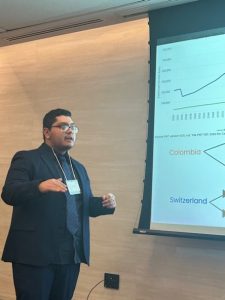
Angel Bravo (’26) presents at the IPE conference, NYC, February 27, 2026
Both students presented the results of the empirical application of the Solow Growth Model comparing economic development of countries of their choice. Isabella Thomas studied Venezuela and Brazil, while Angle Bravo compared Columbia and Switzerland. This research stemmed from the ECON 2012 Q – Intermediate Macroeconomics course taught by Professor Smirnova. The students studied the literature, worked with the Penn World Tables dataset, and applied regression analysis to the time series covering 1950-2019. The results show that countries differ in their economic development paths. The students delve into the reasons for divergence for each country and provided their policy recommendation in each case.
To support Isabella and Angel, the Economics Research and Policy Council (a.k.a. Economics Club) in Stamford, organized the trip to the conference supported by Stamford Student Activities. The group of 12 Stamford Economics students attended the conference and participated in lively academic discussions among the participants.
Heather’s career includes 30 years of experience in for-profit, nonprofit, and public service organizations. Prior to joining the New York Fed in 2015, Heather was the Senior Director of Executive MBA Admissions at New York University Stern School of Business. Before transitioning into education, she led Network Solutions Group Strategy & Planning at Lucent Technologies (now Nokia Bell Labs). She has also taught micro- and macroeconomics as an adjunct professor for the Bard Prison Initiative, working with students at NYS Eastern Correctional Facility.
Heather Daly, Head of Economic Education, Community Development & Education, Communications and Outreach Group, Federal Reserve Bank of New York
Heather earned a Bachelor of Arts and Master of Arts in Political Science from the University of Connecticut, as well as a Master of Business Administration degree from New York University.
At Stamford on February 17, 2026, Ms. Daly presented a talk “Introduction to the Federal Reserve System”, where she took an in-depth look into the history of U.S. Central Banks and the Federal Reserve System. The discussion with students focused on the structure and functions of the Federal Reserve System, and current intricacies of Federal Reserve Board and Federal Open Market Committee (FOMC).
The second focus of Ms. Daly’s presentation was on students’ career preparation. Heather outlined skills and competencies that are needed at the Fed and explained the timeline for opportunities for internships and programs open for various levels of academic preparation.
This unique event, where several Economics classes came together, was conceived and organized by the Economics Research and Policy Council (a.k.a. The Economics Club) in Stamford with support from the Economics Department, its faculty Dr. Couch, and faculty Club Adviser, Dr. Smirnova.
We are grateful to Ms. Daly for coming to campus, sharing her knowledge and expertise, her career “learning journey”, and UConn alumna’s wisdom with Economics students at Stamford.
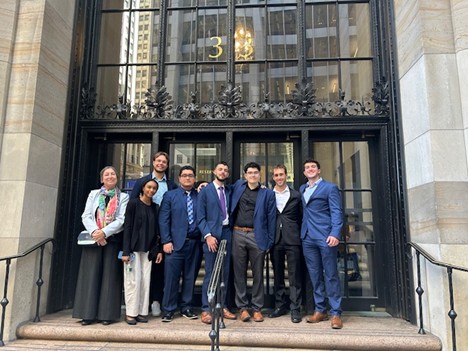
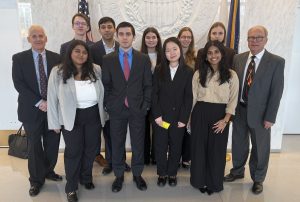
UConn Stamford Fed Challenge Team outside of the New York Fed after the Orientation, September 2025. From left to right: Dr. Smirnova (faculty adviser), Alexys Williams, Dmitrii Tuzov (graduate student adviser), Angel Bravo, Anthony Brunetto, Kothan Nieves-Orama, Jagger Ferrajina, Constantine Lampronikos.
In the Fall 2025, the UConn Stamford team participated again in the national College Fed Challenge competition, where teams analyze economic and financial conditions and formulate a monetary policy recommendation, modeling the Federal Open Market Committee. This year, 139 teams participated in the Challenge, so the competition was fierce. The video of the UConn Stamford team is here.
Here is UConn Stamford’s 2025 College Fed Challenge Team:
Angel Bravo is a B.S. Economics major with minors in Accounting & Mathematics at the University of Connecticut, where he focuses on financial markets, economic research, and quantitative analysis. His coursework in econometrics, financial accounting, and programming has equipped him with a strong analytical foundation that supports his long-term goal of becoming a quantitative analyst in the banking industry.
During his time as a team member of the Fall 2025 College Fed Challenge, Angel contributed research on tariffs and monetary policy implementation. Beyond the classroom, he is also conducting research on global economic development and income inequality among countries, which he will present at an undergraduate research conference in New York. Additionally, he is an active member of the Economics Research & Policy Club and participates in UConn’s Honors Program, where he served as a student facilitator to promote academic curiosity, leadership, and student-led initiatives.
With his combined experience in research and student leadership, Angel also hopes to one day pursue college-level teaching in the further future. He is deeply committed to his academic and professional development and looks forward to advancing his studies through future master’s work and a career in quantitative finance.
Anthony Brunetto is a senior majoring in economics. His interest in the Fed Challenge started when he saw the 2024 team take a picture with the current Federal Reserve Chair, Jerome Powell, posted in the hallway, and from that point, he was determined to join the team. His main contribution to the team was researching inflation and how the Fed’s policy impacted bond and stock markets. Anthony, while studying economics, has an interest in wealth management, which is directly affected by the Fed’s monetary policy, so he took Money and Banking and Practicum to expand his knowledge of how the Federal Reserve operates and how money works. Anthony plans to use his knowledge he gained in the Fed challenge, as well as his undergrad studies, to become a wealth advisor post-grad.
Jagger Ferrajina is a senior Economics major at the University of Connecticut with a strong interest in monetary policy, global markets, and international trade. He works in vessel operations at John F. Dillon & Co., where he has gained hands-on experience in dry bulk shipping, charter parties, and global logistics.
He is actively involved in UConn’s Fed Challenge and serves as Vice President of the Economics Research & Policy Club, helping create opportunities for students to engage with economic policy and current events on the Stamford campus. Through both academic and professional experience, Jagger has developed a strong interest in the intersection of economics, finance, and global trade, and he plans to pursue a career in these fields following graduation.
Constantine Lampronikos is a senior Economics Major at the University of Connecticut with strong interest in Finance and relationship-driven business. He has developed hands-on industry experience through internships in both the tanker and dry-bulk sectors of the shipping industry, where he worked on voyage calculations, freight rate analysis, and operational logistics. He is fascinated by the way business systems interconnect across markets, industries, and economic environments.
Throughout his undergraduate schooling, he has balanced full-time coursework with professional commitments. Recently, he maintained an internship at John F. Dillon & Co as well as his job as a server at Columbus Park Trattoria in Stamford, both while actively participating in the Fed Challenge and being enrolled full-time in school. Constantine prides himself on his work ethic, adaptability, and ability to cooperate with others. He is highly motivated and continually searching to meet people, gain fresh insight, and build new skills. Outside of academics, he enjoys fitness, travel, trying new things, all while spending time with friends and family.
Kothan Nieves-Orama is a Junior Economics student accelerating his academic career through the 4+1 Fast-Track program for a master’s in public policy. His academic pursuits are deeply informed by his professional experience as a Relationship Banker, where he gained firsthand insight into the complexities and impacts of the banking sector.
As the Editor-In-Chief for the Economic Research & Policy Club, Kothan merges his passion for economic theory with his avid interest in History and Philosophy. This role, along with his dedication to synthesizing complex information, has catalyzed his interest in teaching and mentorship. He actively cultivates these skills as a Path Mentor for incoming Freshmen and as an Honors Ube-Facilitator, a key leadership position overseeing Honors First-Year Seminar Courses across regional campuses. This extensive background in leadership positions will help Kothan to seamlessly transition into a career dedicated to educating future generations.
Calebe Velozo is a Brazilian student majoring in economics with a minor in information technology. His interest in the Fed Challenge grew through studying how monetary policy influences the broader economy and financial conditions. Calebe also works at Apple, where he acquired skills to understand the financial aspect of our monetary policy presentation. For the Fed Challenge, Calebe focused on understanding key economic indicators and how they guide policy decisions. He plans to use the knowledge gained from this experience, along with his coursework, to continue developing in the fields of economics, technology, and data driven decision making.
Alexys Williams is a junior honors student at UConn majoring in Economics. She developed an interest in economics through her love of geography and a fascination with how countries and markets are interconnected. She enjoys exploring the world’s complexity and understanding how economic systems influence global outcomes.
She has applied her interests through internships in asset management and private equity, gaining experience in market monitoring and macro-financial analysis. Her coursework in Money and Banking and Quantitative Analysis has provided a strong foundation in both theory and practice. She contributed to the Fed Challenge team by researching labor markets, which deepened her understanding of macroeconomic dynamics. Alexys also serves as Secretary of the Economics Research and Policy Council, a club dedicated to promoting economic literacy and engagement on the UConn Stamford campus. Outside of academics, she enjoys photography, cooking, baking, and aviation. She makes it a goal to constantly learn, embrace new challenges, and grow from every experience.
The Graduate Student Adviser to the team was Dmitrii Tuzov.
Dmitrii Tuzov is a graduate student in the MS in Business Analytics & Project Management program, where he is pursuing advanced studies in data science, machine learning, and AI-driven decision-making. Before joining UConn, Dmitrii worked as a financial and investment analyst and later advanced into roles spanning the full data analytics vertical: business analytics, data science and engineering, where he delivered predictive models, cost-control systems, and data pipelines that informed both operational and strategic decisions.
He served as an advisor for the Stamford Fed Challenge team, supporting students in economic analysis, forecasting, and policy communication. In this role, he advised students on collecting, analyzing, and interpreting macroeconomic data; showed forecasting and econometric techniques; and guided the team’s analytical argumentation and preparation of evidence-based economic presentations. Beyond academics, Dmitrii is actively involved in AI/ML research and business initiatives and is passionate about helping younger students grow both technically and professionally.
The value of participation in the College Fed Challenge competition can not be overestimated. In addition to a deep academic leaning about the conduct of monetary policy in the U.S., students develop many career competencies that will be helpful in their various pursuits after graduation.
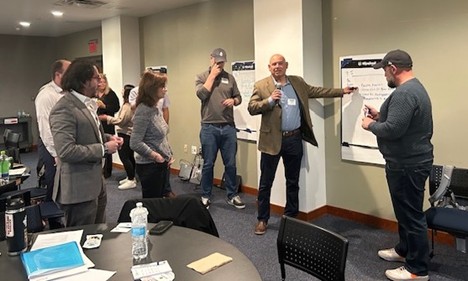
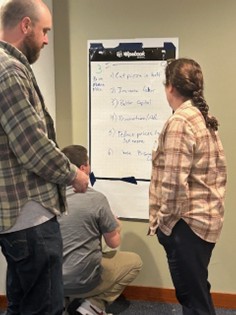
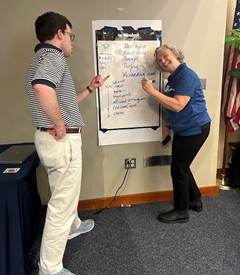
Ralph Russo, ECE Economics instructor at Guilford High School, explains the Vertical Wall activity at the ECE workshop on October 22, 2025, at the Stamford campus
The Early College Experience (ECE) Economics program is one of the largest at UConn. This academic year, we have 36 schools participating, with 50 teachers running 72 sections of introductory Economics courses. Through the ECE, we offer ECON 1000- Essentials of Economics, ECON 1202 – Principles of Microeconomics, and ECON 1202 – Principles of Macroeconomics.
Instructors are certified to teach those courses through a rigorous process of professional development events. The 2025 annual professional development workshop was held on October 22, 2025, at the Stamford campus. We had 31 teachers in attendance.
The speakers included national-level economic educators from Federal Reserve Banks of New York and St. Louis, Marginal Revolution University (MRU), a non-profit provider of economic education materials, and MoneyLing, financial literacy non-profit provider.
The agenda was packed with presentations of innovative pedagogies in the engaging environment:
At the Local Level: Classroom Activities for Microeconomics
The Big Picture: Basics for Teaching Macroeconomics
Global Trade: Who Wins, Who Loses, and Why It Matters
The One Where No One Has a Job: Teaching Unemployment and Labor Force Participation Rates
Teaching and Learning Economics with FRED Data in the High School Classroom
Moneyling – Financial Literacy Program for Schools
Participants explored various techniques that would get their students interested in the economic way of thinking, economic analysis, and contemporary economic issues. Instructors came away with the materials that could be immediately used in their classrooms.
Teachers working on the Vertical Wall assignment
A new feature this year was the sharing of “working well in the classroom” technique by the Guilford High School teacher, Ralph Russo, who demonstrated the “Vertical Wall” activity from the “Building Thinking Classrooms” methodology. The photos show how enthusiastic workshop participants were to engage in this activity. Learning from their colleague and trying out how it feels to be a student in this classroom were the highlights of this demonstration.
Overall, the workshop participants shared their satisfaction with the content of the training. The new location in Stamford was advantageous to the instructors located in Fairfield County.
The Economics Department would like to thank the Stamford Events team for helping with the logistics of this workshop.
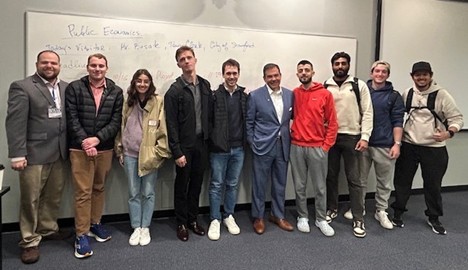
The curriculum of the Public Economics class includes discussions about government finance. It was then appropriate for students at the Stamford campus in Dr. Smirnova’s class to meet a public official from Stamford. Mr. Gerald R. Bosak Jr. has served Stamford as a member of the Board of Finance, the Board of Education, and currently as a Zoning Board Commissioner. He is aspiring to become Town Clerk of the City of Stamford.
Mr. Bosak shared with students how the City’s finance plans are deliberated and how the University negotiated with the City for the new dormitories’ construction. The most heated discussion evolved around the affordable housing issue as well as the overdevelopment of the City’s beach front. Students had a lot of questions for Mr. Bosak regarding cost-benefit analysis’s role in the policy decisions by the Stamford government. All of these public policy issues connect closely with the course curriculum and with the project students are working on in this class.
Mr. Bosak encouraged students to participate in the local government by attending meetings, voicing their concerns and ideas, and volunteering. In the end, the visit not only related the economic concepts of costs and benefits, budgets, deficits and debt to the actual local government functioning. The visit also inspired students to be active citizens in their communities.
Mr. Jerry Bosak, center, with several students from Dr. Smirnova’s Public Economics class on October 16, 2025, at the Stamford campus.
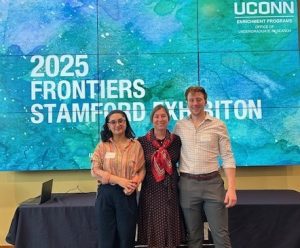
Two Economics students, Madina Mamedli and Cole Sembrot presented their research at the Frontiers in Undergraduate Research Exhibition in Stamford on April 22, 2025. Their academic adviser is Professor Smirnova.
Madina Mamedli presenting her research
Madina’s paper was entitled “From Chalk to Checkbooks: The Real Price of Educational Inequality”. Madina compared the investment in and the outcomes of public and private secondary education institutions in the U.S. Her literature review and regression analysis revealed inadequate funding for public schools, which leads to lower SAT scores, lower college counselor / student ratio, and other disadvantages for students attending public schools. Madina concluded that educational inequality transforms early life privileged into long-term economic advantage. Disparities in school resources, academic support, and access to college counseling directly shape earning potential.
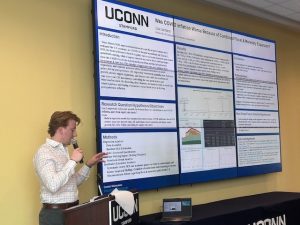
Cole Sembrot presenting his research
Cole Sembrot discerned fiscal and monetary policies’ impacts on the economy during the pandemic. His paper was entitled “Was COVID Inflation Worse Because of Combined Fiscal and Monetary Expansion?” Cole has built the regression model that examines how much post-COVID inflation is due to the actions of the Federal Reserve: near zero interest rates, QE, balance sheet expansion, and money supply growth, while controlling for supply-side shock. Cole concluded that the post-pandemic inflationary episode is due to a complex interplay between policy and external economic shocks.
Madina Mamedli (’25), Dr. Smirnova, Cole Sembrot (’25)
The event was attended by more than 50 people: students, faculty, and staff. There were guests from the Office of Undergraduate Research and UConn Enrichment Programs as well as Stamford campus administration. The atmosphere of the event was academic in nature, but friendly and supportive. 20 students from various fields of study presented their research results. Experiences like this help students gain confidence and prepare for careers upon graduation.
UConn Storrs 2024 Team: from left to right: back row: Professor Derek Johnson (faculty adviser), Spencer Thompson, Viren Chainani, Lilla Korniss, Claire Dobbins, Katrina Melnik, Professor Owen Svalestad (faculty adviser). Front row: Nameeda Elmi, William Infante, Evelyn Zhou and Rai Kumar
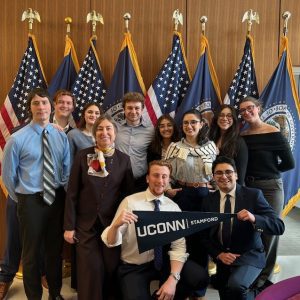
The Economics Department students participate in the College Fed Challenge national competition every year. The Storrs team competes in the Boston district of the Federal Reserve System, and the Stamford team competes in New York. In 2024, the Storrs team was a National Finalist, which is an exceptional achievement. In February 2025, both teams travelled to the Board of Governors of the Federal Reserve System in Washington, DC, for an Open House for all participants.
UConn Stamford 2024 Team: from left to right: back row: Matthew Dalzell, Thomas Surette, Angelina Solodka, Professor Smirnova (faculty adviser), Paul Juszczyk, Liz Maia, Madina Mamedli, Brenda Leon, Mallory Albrecht, front row: Cole Sembrot and Micthell Velasco.
In addition to summarizing results from the 2024 competition, the agenda of the Open House focused on showcasing various segments of the Fed’s functions and sharing career opportunities available at the Board for graduates with bachelor’s degrees. Participants heard from Brian Bonis, Assistant Secretary of the FOMC, Matt Eichner, Director of the Division of Reserve Bank Operations and Payment Systems, and a panel of former Fed Challenge participants, who are now employed as Research Assistants (RAs) at the Board.
The students of both teams were excited to participate in the Open House and are appreciative of the Economics Department as well as other entities that provided funding for this trip. The sponsors are the Business School, CLAS Dean’s Office, UConn Center for Career Readiness and Life Skills, and Stamford campus administration. Thank you!
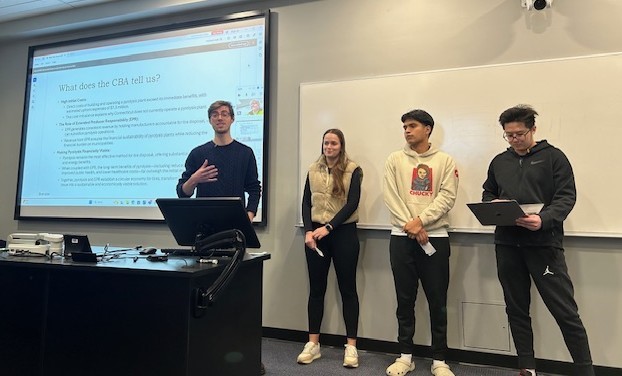
Public Economics students, (from left to right), Brendan Tuite, Abigail McDonough, Isaias Juarez, and Yukun Zhang, present their findings in class on November 19, 2024, Stamford campus
During the Fall 2024, the students in the ECON 3431- “Public Economics” course at the Stamford campus worked with the industry professional to research, analyze, and propose policy solutions to the imminent State of Connecticut problem of Solid Waste Management.
The applied nature of the course allowed students to experience every aspect of public policy development from problem identification, ideation, research of the literature, data gathering, analysis, and policy recommendation formulation.
In addition to Professor Smirnova, who is the instructor of this course, the students worked under the mentorship of Mr. Brian Bartram (CLAS’ 94), who has been the manager of the Salisbury/Sharon (CT) Transfer Station in Connecticut since 2007. At that time Salisbury & Sharon were seeking design ideas to be used in the construction of a new transfer station. Since then, Brian has been active in the Northeast Resource Recovery Association, CT Department of Energy & Environmental Protection’s Solid Waste Advisory Committee, and CT Product Stewardship Council. In 2012 he was appointed by Gov. Malloy to be a member of the Modernizing Recycling Working Group. Brian completed the UConn Master Composter Program in 2015.
Students were assigned to groups to imitate the economic think-tank work environment. Each group selected their topic through the process of ideation based on Brian’s presentation about the acute waste management problem in Connecticut. The following research questions were formulated and answered during the semester:
Cost Benefit Analysis of Installing a Methane Capture System at the Manchester, Connecticut Landfill.
Government Policies Promoting Recycling and Landfill Use Reduction.
Where Did Your Old TV Go?
What is the Most Cost-Effective Waste Conversion Technology for Connecticut Municipalities?
How does Connecticut Dispose of Waste Tires?
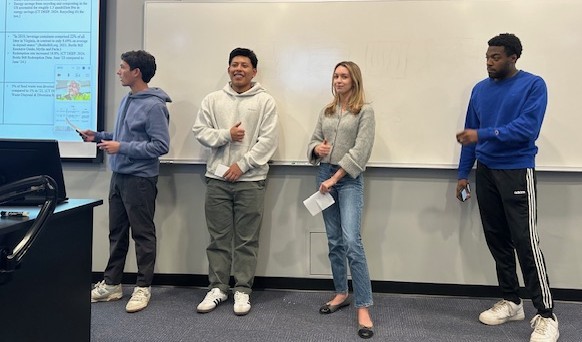
Public Economics students, (from left to right), Sam Jenkins, Jordi Silva, Hannah Geary, and Kyle Nelson, present their findings in class on November 19, 2024, Stamford campus
At the completion of the course, student teams presented their findings to the class with Mr. Bartram visiting the class virtually, asking questions, and commenting on issues. Brian reflected that he “really enjoyed how different student teams were looking at the issue from different angles. Solid waste is a national, regional, state, and local issue. All different views and situations need to be considered and assessed.”
Through this exercise, students learned to collaborate with and present and defend their findings to the industry expert. Collaborative experiences such as this, between UConn students and the State of Connecticut professionals, are invaluable in preparing our students for careers in industries and the public sector. By integrating the workplace analytical approaches into the curriculum of applied courses, we are teaching students career competencies that are demanded of them upon graduation.