Web cookies (also called HTTP cookies, browser cookies, or simply cookies) are small pieces of data that websites store on your device (computer, phone, etc.) through your web browser. They are used to remember information about you and your interactions with the site.
Purpose of Cookies:
Session Management:
Keeping you logged in
Remembering items in a shopping cart
Saving language or theme preferences
Personalization:
Tailoring content or ads based on your previous activity
Tracking & Analytics:
Monitoring browsing behavior for analytics or marketing purposes
Types of Cookies:
Session Cookies:
Temporary; deleted when you close your browser
Used for things like keeping you logged in during a single session
Persistent Cookies:
Stored on your device until they expire or are manually deleted
Used for remembering login credentials, settings, etc.
First-Party Cookies:
Set by the website you're visiting directly
Third-Party Cookies:
Set by other domains (usually advertisers) embedded in the website
Commonly used for tracking across multiple sites
Authentication cookies are a special type of web cookie used to identify and verify a user after they log in to a website or web application.
What They Do:
Once you log in to a site, the server creates an authentication cookie and sends it to your browser. This cookie:
Proves to the website that you're logged in
Prevents you from having to log in again on every page you visit
Can persist across sessions if you select "Remember me"
What's Inside an Authentication Cookie?
Typically, it contains:
A unique session ID (not your actual password)
Optional metadata (e.g., expiration time, security flags)
Analytics cookies are cookies used to collect data about how visitors interact with a website. Their primary purpose is to help website owners understand and improve user experience by analyzing things like:
How users navigate the site
Which pages are most/least visited
How long users stay on each page
What device, browser, or location the user is from
What They Track:
Some examples of data analytics cookies may collect:
Page views and time spent on pages
Click paths (how users move from page to page)
Bounce rate (users who leave without interacting)
User demographics (location, language, device)
Referring websites (how users arrived at the site)
Here’s how you can disable cookies in common browsers:
1. Google Chrome
Open Chrome and click the three vertical dots in the top-right corner.
Go to Settings > Privacy and security > Cookies and other site data.
Choose your preferred option:
Block all cookies (not recommended, can break most websites).
Block third-party cookies (can block ads and tracking cookies).
2. Mozilla Firefox
Open Firefox and click the three horizontal lines in the top-right corner.
Go to Settings > Privacy & Security.
Under the Enhanced Tracking Protection section, choose Strict to block most cookies or Custom to manually choose which cookies to block.
3. Safari
Open Safari and click Safari in the top-left corner of the screen.
Go to Preferences > Privacy.
Check Block all cookies to stop all cookies, or select options to block third-party cookies.
4. Microsoft Edge
Open Edge and click the three horizontal dots in the top-right corner.
Go to Settings > Privacy, search, and services > Cookies and site permissions.
Select your cookie settings from there, including blocking all cookies or blocking third-party cookies.
5. On Mobile (iOS/Android)
For Safari on iOS: Go to Settings > Safari > Privacy & Security > Block All Cookies.
For Chrome on Android: Open the app, tap the three dots, go to Settings > Privacy and security > Cookies.
Be Aware:
Disabling cookies can make your online experience more difficult. Some websites may not load properly, or you may be logged out frequently. Also, certain features may not work as expected.
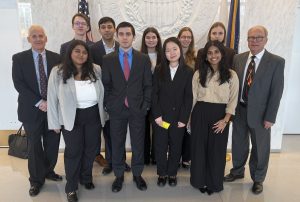
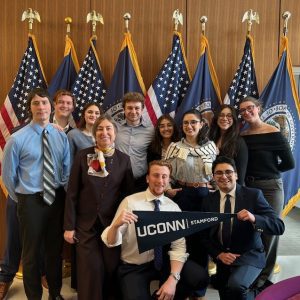
UConn Storrs 2024 Team: from left to right: back row: Professor Derek Johnson (faculty adviser), Spencer Thompson, Viren Chainani, Lilla Korniss, Claire Dobbins, Katrina Melnik, Professor Owen Svalestad (faculty adviser). Front row: Nameeda Elmi, William Infante, Evelyn Zhou and Rai Kumar
The Economics Department students participate in the College Fed Challenge national competition every year. The Storrs team competes in the Boston district of the Federal Reserve System, and the Stamford team competes in New York. In 2024, the Storrs team was a National Finalist, which is an exceptional achievement. In February 2025, both teams travelled to the Board of Governors of the Federal Reserve System in Washington, DC, for an Open House for all participants.
UConn Stamford 2024 Team: from left to right: back row: Matthew Dalzell, Thomas Surette, Angelina Solodka, Professor Smirnova (faculty adviser), Paul Juszczyk, Liz Maia, Madina Mamedli, Brenda Leon, Mallory Albrecht, front row: Cole Sembrot and Micthell Velasco.
In addition to summarizing results from the 2024 competition, the agenda of the Open House focused on showcasing various segments of the Fed’s functions and sharing career opportunities available at the Board for graduates with bachelor’s degrees. Participants heard from Brian Bonis, Assistant Secretary of the FOMC, Matt Eichner, Director of the Division of Reserve Bank Operations and Payment Systems, and a panel of former Fed Challenge participants, who are now employed as Research Assistants (RAs) at the Board.
The students of both teams were excited to participate in the Open House and are appreciative of the Economics Department as well as other entities that provided funding for this trip. The sponsors are the Business School, CLAS Dean’s Office, UConn Center for Career Readiness and Life Skills, and Stamford campus administration. Thank you!
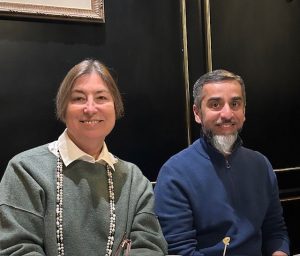
During the trip to the Open House at the Federal Reserve Board, UConn-Stamford 2024 Team of the College Fed Challenge competition had an opportunity to meet with UConn alum, Misbah Seyal. Mr. Seyal is a real estate professional with a substantive career including various positions at Moody’s, Wells Fargo, Bank of America, and other financial services firms.
Natalia Smirnova, faculty, (left) and Misbah Seyal, UConn alum (BA’97, MBA’04), at dinner with students on February 6, 2025, in Washington, DC.
During the meeting with students, Misbah talked about career opportunities after graduation from UConn. He emphasized the importance of developing skills that could be transferred to the workplace and of being adaptable to labor market conditions as they change.
Students were interested in learning about the real estate sector as well as about the financial sector. They were curious about navigating the competitive market environment and about balancing career expectations and family. Misbah shared his wisdom and encouraged students to pursue their passions and dreams.
The students, as well as Dr. Smirnova, faculty adviser to the College Fed Challenge team, are grateful to Mr. Seyal for his time with us. We are also appreciative of Ms. Siobhan Lidington, Director of Development, School of Business, University of Connecticut Foundation, for her efforts to make this meeting possible.
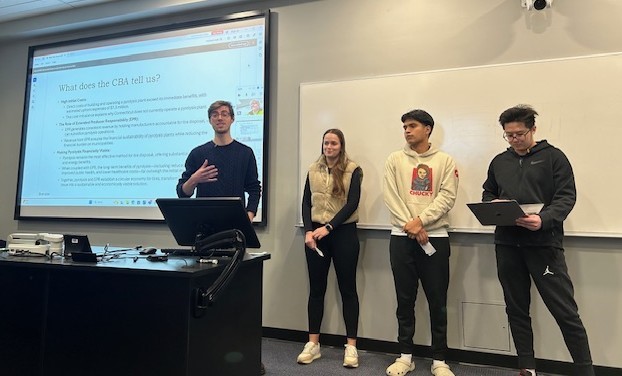
Public Economics students, (from left to right), Brendan Tuite, Abigail McDonough, Isaias Juarez, and Yukun Zhang, present their findings in class on November 19, 2024, Stamford campus
During the Fall 2024, the students in the ECON 3431- “Public Economics” course at the Stamford campus worked with the industry professional to research, analyze, and propose policy solutions to the imminent State of Connecticut problem of Solid Waste Management.
The applied nature of the course allowed students to experience every aspect of public policy development from problem identification, ideation, research of the literature, data gathering, analysis, and policy recommendation formulation.
In addition to Professor Smirnova, who is the instructor of this course, the students worked under the mentorship of Mr. Brian Bartram (CLAS’ 94), who has been the manager of the Salisbury/Sharon (CT) Transfer Station in Connecticut since 2007. At that time Salisbury & Sharon were seeking design ideas to be used in the construction of a new transfer station. Since then, Brian has been active in the Northeast Resource Recovery Association, CT Department of Energy & Environmental Protection’s Solid Waste Advisory Committee, and CT Product Stewardship Council. In 2012 he was appointed by Gov. Malloy to be a member of the Modernizing Recycling Working Group. Brian completed the UConn Master Composter Program in 2015.
Students were assigned to groups to imitate the economic think-tank work environment. Each group selected their topic through the process of ideation based on Brian’s presentation about the acute waste management problem in Connecticut. The following research questions were formulated and answered during the semester:
Cost Benefit Analysis of Installing a Methane Capture System at the Manchester, Connecticut Landfill.
Government Policies Promoting Recycling and Landfill Use Reduction.
Where Did Your Old TV Go?
What is the Most Cost-Effective Waste Conversion Technology for Connecticut Municipalities?
How does Connecticut Dispose of Waste Tires?
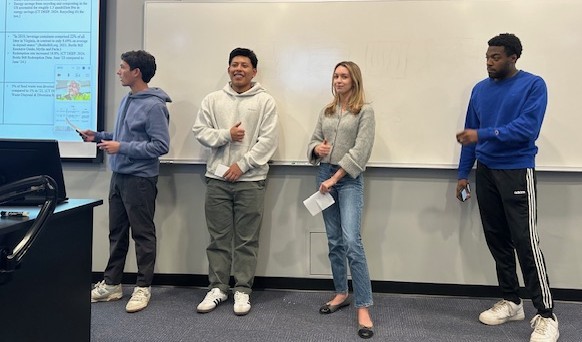
Public Economics students, (from left to right), Sam Jenkins, Jordi Silva, Hannah Geary, and Kyle Nelson, present their findings in class on November 19, 2024, Stamford campus
At the completion of the course, student teams presented their findings to the class with Mr. Bartram visiting the class virtually, asking questions, and commenting on issues. Brian reflected that he “really enjoyed how different student teams were looking at the issue from different angles. Solid waste is a national, regional, state, and local issue. All different views and situations need to be considered and assessed.”
Through this exercise, students learned to collaborate with and present and defend their findings to the industry expert. Collaborative experiences such as this, between UConn students and the State of Connecticut professionals, are invaluable in preparing our students for careers in industries and the public sector. By integrating the workplace analytical approaches into the curriculum of applied courses, we are teaching students career competencies that are demanded of them upon graduation.
Last Thursday, October 17, 2024, the Department of Economics held its regular semester GA Training Workshop, aimed at preparing new Graduate Assistants for their teaching responsibilities. Three faculty members—Professors Talia Bar, Professor Kai Zhao, and Professor Tianxu Chen—shared valuable advice drawn from their teaching experience.
Professor Bar emphasized the importance of adapting to students’ varying levels of mathematical proficiency, using active learning strategies to keep students engaged, and proactively addressing potential classroom challenges.
Professor Zhao reflected on his early teaching experiences, offering advice on understanding student backgrounds, using relatable examples, and ensuring clear communication to avoid confusion.
Professor Chen concluded the session by focusing on classroom management, encouraging a positive learning environment, and balancing teaching duties with academic responsibilities. Her practical tips provided GAs with useful strategies for success.
This workshop remains a cornerstone of the department’s efforts to support GAs, offering them essential tools and insights to excel in both teaching and their academic progress each semester.
Recent UConn graduates Aaron Cooke (2018 PhD, U.S. Department of the Treasury) and Umesh Ghimire (2021 PhD, Commonwealth University of Pennsylvania) have had their paper accepted for publication in Macroeconomic Dynamics.
The paper examines the impact of life-cycle savings, intergenerational transfers, and fertility differences between the rich and the poor on the wealth distribution in the United States
Kai ZhaoHyun Lee
This paper is a joint work with Dr. Hyun Lee (former UConn faculty) and Professor Kai Zhao. The key message of the paper is that the fertility differences between the rich and the poor significantly amplify the role of bequests in shaping the U.S. wealth inequality.
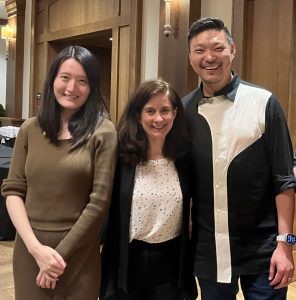
Sewanee is among the nation’s top national liberal arts colleges and is consistently ranked as one of the top five in the South. While Professor Furtado enjoyed walking around the beautiful campus, often spotting students and faculty in their academic gowns, her favorite part of the trip was catching up with former UConn students.
Huari’s research interests are in asset pricing, financial econometrics, macro finance, and machine learning. At Sewanee, she teaches the courses, Investment Finance, Derivatives and Fixed Income Securities, Financial Modeling, and Financial Engineering.
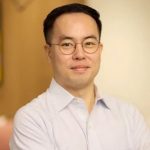
Tao’s research interests are in labor and urban economics with a particular focus on immigration. He has taught Microeconomics, Macroeconomics, and Econometrics as well as the field courses Labor Economics, Urban Economics, and the Economics of Immigration. This month, he was awarded tenure and promoted to associate professor. Congratulations, Tao!
Current UConn PhD students, do reach out to Huari and Tao for advice on building a successful academic career at a liberal arts college.
Former UConn PhD students, we would love to know where you are and what you’re up to! Contact Lisa Bono at lisa.bono@uconn.edu.
Two graduate students in the UConn Department of Economics presented their research at the New England Experimentalist Workshop last week.
Anastassiya Karaban presented her paper, “The role of gender comparisons in determining reference wage and labor supply.” She finds that when people make different wages, we choose to compare our wage to others of the same gender. Women work harder when making more than other women (but not when making more than other men). Men work less hard if they are making less than another man (but not if they are making less than a woman).
Victor Volkman presented his paper, “Race and experimental design: How respondents may read context into a neutrally framed scenario.” Traditionally, economics experiments have participants engage in “context free” simulated economic transactions. Victor examines whether such absence of context can affect individuals differently based on their racial backgrounds. He finds evidence that different racial groups interpret context-free scenarios differently, and thus their actions are not directly comparable.
The presentations offered the students both broader exposure for their research and a chance to receive valuable feedback from researchers at other universities.
On July 1 and 2, the Department of Economics hosted the annual New England Experimentalist Workshop.
The Workshop brought together experimental and behavioral economists from twelve universities to present research on topics as diverse as gender pay disparities, self-censorship of political views in the classroom, and effective environmental policy.
The two-day workshop was organized by faculty members Remy Levin and Mike Shor and graduate student Anastassiya Karaban.
Mara Gauger (’13) at the Stamford campus on April 9, 2024
Students in Professor Smirnova’s Financial Economics and Money and Banking classes were visited by UConn Alumna, Mara Gauger (’13) on Tuesday, April 9, 2024.
Mara Gauger graduated from UConn with BA degree in Economics in 2013. After graduation, she worked at Citi, and achieved the level of Assistant Vice President. Since 2016 she works at Deloitte.
Mara Gauger is currently a Senior Manager Deloitte’s Capital Markets practice with extensive experience supporting securities firms and broker-dealers. Mara focuses on assisting firms on topics related to securities operations, trading systems, and risk management programs. At Deloitte, Mara has been a lead in the SEC Rule 613 Consolidated Audit Trail project office as well as assisting firms in their design and implementation of the rule requirements. Mara is also a core member of the Deloitte team supporting SIFMA, ICI, and DTCC’s efforts to analyze the impacts of an accelerated settlement cycle (T+1) since inception.
The goal of Mara’s visit was to familiarize students with careers in the financial sector, and mentor them on how to get their first job upon graduation from UConn with the Economics degree. Mara generously shared her wisdom about how to navigate the process of job and internship search: what to showcase on the resume to stand out; how to network through LinkedIn and HuskyLink; how to prepare for and conduct interviews; how to utilize the Career Center and Career Fairs; and what skills and career competencies are in demand in the marketplace.
Students were able to ask questions pertaining to their career aspirations and their experiences with internships and job search. Students who are seniors were the most vocal and were able to ask the most pointed and specific questions. Students who are juniors and sophomores received a motivational advice to start their networking as early as possible. Mara suggested utilizing HuskyLink as the first step of connecting with the UConn alumni.
Mara Gauger (’13) (right) and Dr. Smirnova at the Stamford campus on April 9, 2024
Mara shared that her visit to UConn is the way to give back to her Alma Mater after working in the financial industry for 10 years. She was very supportive of students’ inquiries and honest about identifying the competitiveness of the industry and challenges of getting the first job out of college. Students took her advice and candid conversation in stride. They were encouraged by Mara to continue their studies, gain career competencies, and confidently showcase their strengths and skills to the employers.
Thank you, Mara Gauger (’13) for visiting us at UConn Stamford. We really appreciate it!


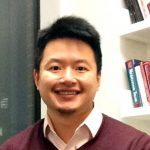
 Huari’s research interests are in asset pricing, financial econometrics, macro finance, and machine learning. At Sewanee, she teaches the courses, Investment Finance, Derivatives and Fixed Income Securities, Financial Modeling, and Financial Engineering.
 Current UConn PhD students, do reach out to Huari and Tao for advice on building a successful academic career at a liberal arts college.
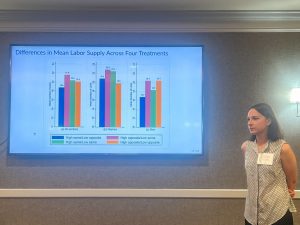 Anastassiya Karaban presented her paper, “The role of gender comparisons in determining reference wage and labor supply.” She finds that when people make different wages, we choose to compare our wage to others of the same gender. Women work harder when making more than other women (but not when making more than other men). Men work less hard if they are making less than another man (but not if they are making less than a woman).
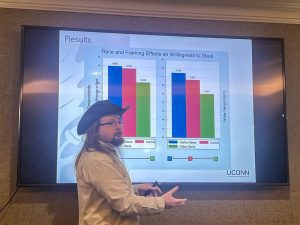 Victor Volkman presented his paper, “Race and experimental design: How respondents may read context into a neutrally framed scenario.” Traditionally, economics experiments have participants engage in “context free” simulated economic transactions. Victor examines whether such absence of context can affect individuals differently based on their racial backgrounds. He finds evidence that different racial groups interpret context-free scenarios differently, and thus their actions are not directly comparable.