From UConn PhD to the AER: Matt Ross Returns to Campus to Present His Research

On October 13, 2026, Matthew Ross (UConn PhD 2016) came back to campus to present his paper “Do Better Detectives Reduce Crime?” in our department seminar. Matt is an Associate Professor at Northeastern University, jointly appointed in the School of Public Policy & Urban Affairs and the Department of Economics.

Matt Ross presenting at the Department Seminar

Using data on more than 160,000 criminal investigations in Austin, Texas, Matt showed that hiring higher-quality detectives raises arrest rates. The gains come both on the new detectives’ own cases and on cases handled by their colleagues. It was a lively talk, with plenty of questions from faculty and students. Matt also spent a full day meeting with his former professors, new professors, and current PhD students.

The seminar comes on the heels of a major publication. Matt’s paper “The Effect of Field Training Officers on Police Use of Force,” with Chandon Adger and CarlyWill Sloan, appeared in the May 2026 issue of the American Economic Review.

Matt wrote his dissertation under Professor Couch (chair), and Professor Furtado and Professor Ray were on his committee. He won the department’s Third Year Paper Award and the University of Connecticut Dissertation Award while he was here. Much of Matt’s work on racial profiling in police stops is with Professor Ross as well as former and current UConn students. This includes a recent paper in the Journal of Human Resources with Jesse Kalinowski (UConn PhD 2018). It also includes ongoing research with current PhD students, Xiaofeng Gong and Da Xu, using cell phone mobility data.

Thank you for coming back to share your work, Matt! You can learn more about his research at https://www.mbross-econ.com/.

Personal Finance Workshop at Stamford

The Center for Academic Success & Engagement (CASE) is the academic support hub at the Stamford campus. It supports students’ academic success by offering tutoring, workshops, and personalized services to help them thrive and provides resources and tools to help students develop skills to grow both academically and personally.

Natalia Smirnova presenting the Financial Literacy Workshop at Stamford’s CASE
Dr. Smirnova presenting the Financial Literacy Workshop at Stamford’s CASE on October 8, 2026

On October 8, 2026, Professor Smirnova from the Economics Department conducted the workshop in Personal Finance. She started by saying that each of us is a CFO (Chief Financial Officer) of our own life, and so we need to develop strong knowledge and competent skills to make sound financial decisions for ourselves.

Since it was the second instalment of the Financial Literacy workshop at CASE, the agenda for this workshop blended together revisiting the concepts such as the interest rate and the time value of money and bringing forward new concepts of the power of interest compounding, debt and debt management, and the FICO credit score.

Students in attendance were able to ask questions and check their understanding of the use of credit cards and the strategies of obtaining their credit reports.

Dr. Smirnova is passionate about disseminating knowledge about financial concepts to her students inside and outside of the classroom. She is part of the followers of the Stanford University Initiative for Financial Decision Making (IFDM) and recently attended the Stanford University Conference on Teaching Personal Finance where she obtained new instructional materials, some of which were used at the CASE event.

The financial literacy programming at the Center for Academic Success & Engagement (CASE) at the Stamford campus is very important. Our students make decisions about loans for college tuition and cars, along with managing credit cards, health and other kinds of insurance, and living within a budget. In the future, they must be able to navigate a multifaceted financial landscape facing complex financial decisions with potentially long-lasting consequences at all stages of life. Therefore, our students must become intelligent and disciplined managers of their personal finances. We thank CASE for making strides in achieving this goal.

Stamford Students Visit New York Fed and New York Stock Exchange

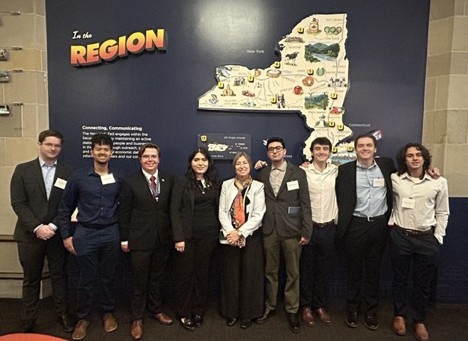
On Friday, September 18, 2026, the College Fed Challenge Stamford team visited the Federal Reserve Bank of New York (FRBNY) for the Orientation for the 2026 competition. Students were greeted by the New York Fed President and CEO, John C. Williams, who shared his economic outlook and answered students’ questions.

The event also included presentations from the Market Group and the Education Department. Students received a lot of valuable information about the state of the economy, the operations of the New York Fed, and about the competition.

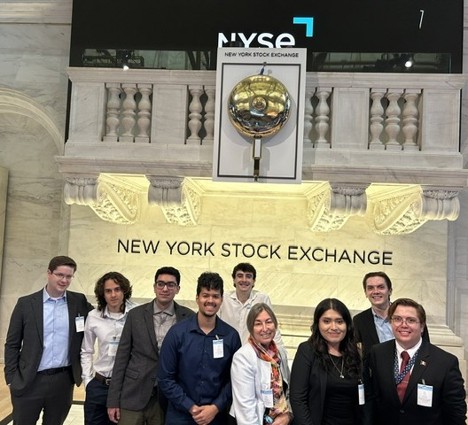
With the help of Aidan Connolly (’21), UConn Stamford Economics and College Fed Challenge alum, the team had gotten the opportunity to visit the New York Stock Exchange (NYSE) afterwards. The students saw the equity floor and the options floor, as well as the NYSE bell. Since this was an expiry day, the options exchange was very busy, and students got a first-hand account of the hectic market atmosphere. We are grateful to Aidan Connolly (’21) and his contacts at NYSE for an informative visit.

The faculty adviser to the Stamford Fed Challenge team is Professor Smirnova who encourages students’ exposure to economists, business experts, and alumni through extracurricular professional activities outside the University. Dr. Smirnova believes that unique opportunities, such as these, help Stamford Economics students gain professional competencies and skills that are transferrable from the college classroom to the workplace and prepare them well for careers upon graduation.

At the Federal Reserve Bank of New York

At the Federal Reserve Bank of New York
From L to R: Stephen Sandor, Alexys Paola, Rene Serrano, Stacy Urvina-Chimbo, Dr. Smirnova, Brendyn Marroquin, Ian Balloch, Gavin Kempa, Philip Childakos

At the New York Stock Exchange (NYSE)

At the New York Stock Exchange (NYSE)
From L to R: Stephen Sandor, Philip Childakos, Brendyn Marroquin, Alexys Paola, Ian Balloch, Dr. Smirnova, Stacy Urvina-Chimbo, Gavin Kempa, Rene Serrano

Professors Harmon and Hwang in UConn Today: NFL Stadium Attendance Protest Impact Depended on Who Visited

Professors Oskar Harmon and Jungbin Hwang are featured in the current edition of UConn Today:

Home or Away? NFL Stadium Attendance Protest Impact Depended on Who Visited, Researchers Find

How do player politics affect fan attendance? The answer is complicated

Research inspiration can come from any number of places.

For Oskar Harmon, an associate professor in the Department of Economics at UConn, a recently published paper was inspired by a conversation with a friend.

About football.

“One of my close friends said they were no longer going to watch NFL games,” Harmon explains. “I was a bit surprised, because he’s normally open to different points of view. So that’s what motivated me.”

What discouraged Harmon’s friend was the widely publicized NFL player protests during televised U.S. national anthem proceedings at the start of games.

Player protests, notes Harmon, became one of the most visible controversies facing the NFL during the 2016 and 2017 seasons, as players like the San Francisco 49ers quarterback Colin Kaepernick sat or kneeled as the anthem was played live on network television.

In 2018, major broadcast networks discontinued live coverage of national anthem ceremonies, greatly reducing visibility of player protests. But the interest in what happened in 2016 and 2017 didn’t wane for Harmon.

“I was looking at how television ratings changed during the protests,” Harmon explains, “and I was really surprised that no one was asking about what happened inside the stadiums. Do all people feel so strongly that they’re not going to go to the games? Because people are very committed to football. And I didn’t see anybody in the literature looking at it.”

Despite media reports of a decline in television viewership and attendance at NFL games amidst the protests, academic research has been limited.

In a review of published studies, Harmon found that a few looked at television viewership responses to the anthem protests, but none examined in-stadium game attendance.

Harmon, who studies consumer behavior and behavioral economics and is a football fan himself – “And I’m very, very, very disappointed in the Giants,” he quips, “but I still watch their games” – partnered with fellow associate professor Jungbin Hwang, an econometrics researcher who uses statistical and mathematical theory to analyze economic data, to see what happened to NFL stadium game-day attendance during the height of the NFL protests in 2016 and 2017.

Their findings were recently published in the June edition of the Southern Economic Journal.

Read the full article at UConn Today:

Home or Away? NFL Stadium Attendance Protest Impact Depended on Who Visited, Researchers Find

Professor Levin and Professor Vidart in VoxEU

Professors Remy Levin and Daniela Vidart have published a column in VoxEU – the policy portal of the Centre for Economic Policy Research (CEPR):

Early-life experiences of labour markets faced by others can leave permanent scars on men’s willingness to work

Labour force participation among prime-aged American men has fallen for over half a century, and standard explanations leave much of the decline unaccounted for. This column combines panel and survey data to show that the labour markets these men experienced while growing up shaped their willingness to work decades later. These effects survive childhood moves across states and likely operate through men’s beliefs about whether work will pay off. If temporary downturns in labour demand can persistently influence labour supply, anchoring expectations about employment, not just inflation, may have a place in macroeconomic policy.

The full column is available at:

https://cepr.org/voxeu/columns/early-life-experiences-labour-markets-faced-others-can-leave-permanent-scars-mens

UConn at ASHEcon

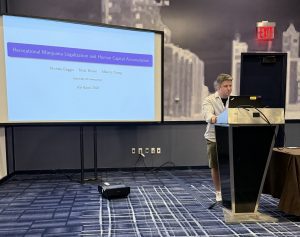
Matthew Brown at ASHEcon26Members of the Department of Economics recently presented their research at the 2026 Conference of the American Society of Health Economists (ASHEcon), held in Minneapolis, MN.

PhD candidate Matt Brown presented “Recreational Marijuana Legalization and Human Capital Accumulation” (coauthored with Professor Baggio and Alberto Chong, Georgia State University). The paper examines how recreational marijuana legalization has affected educational outcomes in the United States. The paper shows that legalization reduced the share of young adults obtaining a GED-or-higher educational attainment and lowered middle school test scores. The study also finds evidence that these laws reduced parental investments in children, as measured by parental time with children, home environment, and cases of child maltreatment.

Professor Ritter presented two papers. The first, “Does Early-Life Medicaid Protect Against Pandemic Mortality? Evidence from COVID-19” (coauthored with Michael DiNardi, a 2018 graduate of UConn’s Economics PhD program and current faculty member at the University of Rhode Island), examines whether childhood Medicaid eligibility improved resilience to later-life mortality shocks. Using mortality data from 2010–2022 and variation from the staggered rollout of Medicaid across states, the paper shows that each additional year of Medicaid eligibility at ages 0–5 reduced adult mortality substantially, with similar effects before and during COVID-19, no significant effects for eligibility at older ages, and a narrowing of racial mortality disparities.

The second paper, “Twice Unlucky: The Interaction of Early-Life Cholera and Adult COVID-19 on Mortality” (with Ricardo Sanchez, Barcelona School of Economics), investigates whether prenatal exposure to Peru’s 1991 cholera epidemic increased vulnerability to COVID-19 mortality decades later. Combining cholera, mortality, and survey data in a quasi-experimental framework, the authors find that greater first-trimester cholera exposure increased COVID-19 mortality among working-age women.

Andy Zhang, Econ Undergraduate, receives Provost Award for Excellence in Community Engaged Scholarship

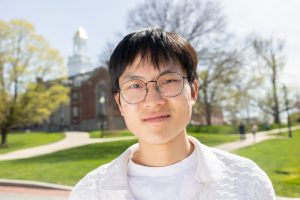
Andy Zhang '26 (CLAS) poses for a photo near Wilbur Cross on Tuesday, April 29, 2025Congratulations to Andy Zhang, Economics ’26, who received the Provost Award for Excellence in Community Engaged Scholarship in the Undergraduate Student category!

From UConn Today:

Andy Zhang ’26 (CLAS & CAHNR), exemplifies the highest standards of community-engaged scholarship through sustained leadership, innovative problem-solving, measurable community impact, and deep personal and academic growth. Over the past three years, Andy has not only contributed meaningfully to the University of Connecticut’s sustainability initiatives but has fundamentally strengthened the infrastructure through which students, faculty, and community members engage with environmental work.

Andy’s leadership has been both sustained and progressively expansive. Beginning as a Sustainability Intern with the UConn Office of Sustainability, he quickly assumed increasing responsibility across multiple high-impact initiatives. He led the coordination of UConn’s annual Class Tree planting and Arbor Day programming, managing complex logistics, cross-sector partnerships, and public engagement efforts. Simultaneously, he has taken on leadership roles in student governance and founded the UConn Chapter of Plant Futures organization, where he leads a growing team focused on advancing sustainable food systems. His leadership trajectory demonstrates not only longevity but also a clear pattern of increasing scope, responsibility, and influence across campus and community initiatives.

Andy’s work is distinguished by a strong commitment to innovation and entrepreneurial thinking. Most notably, he founded the ECollaboration Sustainability Network (ESN), a first-of-its-kind initiative designed to break down silos within UConn’s sustainability community. By leveraging a digital platform, Andy created an accessible and inclusive space that connects students, faculty, and staff across disciplines, enabling real-time collaboration, resource sharing, and engagement. He has also introduced new programming such as the “Sustainability Social,” fostering interdisciplinary dialogue and collaboration. Additionally, his data-driven work analyzing campus dining systems to reduce single-use waste reflects a creative integration of research, policy, and practice to address real-world sustainability challenges.

Andy’s initiatives have produced clear, measurable outcomes that demonstrate meaningful community impact. The ECollaboration Sustainability Network has grown to include over 300 active members spanning diverse academic and professional backgrounds, significantly increasing participation in sustainability initiatives across campus. His Sustainability Social events have brought together over 50 participants per session, catalyzing new partnerships and collaborative projects. His contributions to UConn’s Green Metric report and Tree Campus USA application support institutional benchmarking and recognition, amplifying the university’s impact on a global scale. Additionally, his advocacy for reusable dining programs directly addresses waste reduction, with the potential to eliminate hundreds of thousands of single-use items annually.

Andy’s engagement in community-based work has driven exceptional intellectual, professional, and personal growth. As a dual major in Economics and Environmental Science with a perfect academic record, he integrates rigorous academic training with applied sustainability practice. Through his leadership experiences, Andy has developed advanced skills in project management, stakeholder engagement, policy analysis, and data-driven decision-making. His increasing confidence and initiative, evidenced by founding new organizations, leading large-scale projects, and presenting diverse audiences, reflecting a deep and ongoing commitment to growth as both a scholar and practitioner.

Collaboration is central to Andy’s work. Across all his initiatives, he has engaged a wide range of stakeholders, including students, faculty, administrators, community organizations, and government partners. His leadership in the ESN fosters continuous collaboration among over 300 participants, while his work on institutional sustainability reporting requires coordination with multiple university departments. His partnerships with dining services, and engagement with external organizations demonstrate his ability to build and sustain meaningful, cross-sector relationships that strengthen community outcomes.

Read the whole article at:

UConn Provost Announces 2026 Awards for Excellence in Community Engaged Scholarship

Professor Furtado in UConn Today: Impacts of Immigration on Nursing Home Care

Professor Delia Furtado is featured in the current issue of UConn Today:

UConn Professor Examines Impacts of Immigration on Nursing Home Care

Study finds that local immigration reduces mortality and improves quality of life for nursing home residents

The United States is on the brink of a crisis in elder care. Reports of an aging population have not been exaggerated – it is no longer the case that a relatively small population of older adults can be supported physically and financially by a much larger population of working adults. Thanks to both the Baby Boom and lifespan-enhancing advances in medicine, these groups are now more similar in size. 

Where does that leave older adults today – especially those who struggle with ADLs, or activities of daily living? 

Many older adults are cared for in nursing homes. These facilities are exorbitantly expensive (the average yearly price for a private room in a nursing home in Connecticut exceeds $200,000, according to CareScout) and often understaffed.

professional headshot“You’d think that with that amount of money, staying in a nursing home should be like staying in a five-star hotel, but no,” says Delia Furtado, professor of economics.

Furtado is interested in how an unexpected variable – immigration — may impact the quality of care that nursing home residents receive. 

“I’ve been working on immigration my entire career — over 20 years now,” says Furtado. Her previous research has explored the assimilation process of immigrants and their impacts on the native population via their work in childcare and housekeeping. 

Furtado’s recently published research in the Journal of Human Resources found that when more people immigrate to a certain geographic area, it leads to better care outcomes for nursing home residents in that area...

Read the full article at UConn Today:

UConn Professor Examines Impacts of Immigration on Nursing Home Care

Spotlight on Alumni: Nicholas Jolly, PhD ’08, Promoted to Full Professor

Nicholas (Nick) Jolly, PhD ’08, was recently promoted to full professor of economics at Marquette University, effective beginning in the 2026–27 academic year. A labor economist, his research focuses on the labor market outcomes and adjustment processes of workers who experience involuntary job separations and work-limiting disabilities. He has also published research on collective bargaining agreements in professional sports.

Although nearly two decades have passed since Nick defended his dissertation, he remains closely connected to the department. Most recently, he coauthored a paper with Professor Delia Furtado in the Oxford Review of Economic Policy examining how immigrant labor may help address eldercare worker shortages in the United States. He also contributed, with several coauthors, a chapter on regional variation in COVID-19 vaccination rates to the Handbook on Inequality and COVID-19, edited by Professor Ken Couch.

Nick remains a devoted Huskies fan. He regularly returns to Connecticut during the summer to visit family and can often be spotted in the UConn Bookstore restocking his Husky gear. During his visits, he typically stops by the department and is always generous with his time meeting current PhD students and faculty. If you would like to connect with Nick — or simply congratulate him on his promotion — feel free to reach out to him.

To our other UConn economics alumni: if you have exciting career news to share, please contact economics@uconn.edu. We would love to hear from you.

Professor Vidart Appointed NBER Research Fellow

professional headshotProfessor Daniela Vidart has been named a Faculty Research Fellow in the Development of the American Economy Program of the National Bureau of Economic Research (NBER).

https://www.nber.org/people/daniela_vidart

The Development of the American Economy Program “explores the sources of long-run growth and fluctuations in the US economy. It considers the contributions of human and physical capital, as well as the role of public policy.”

Professor Vidart’s research bridges macroeconomics and economic history to study human capital accumulation and its impacts on labor market outcomes and economic growth.